Spanish Mission

Scroll Down

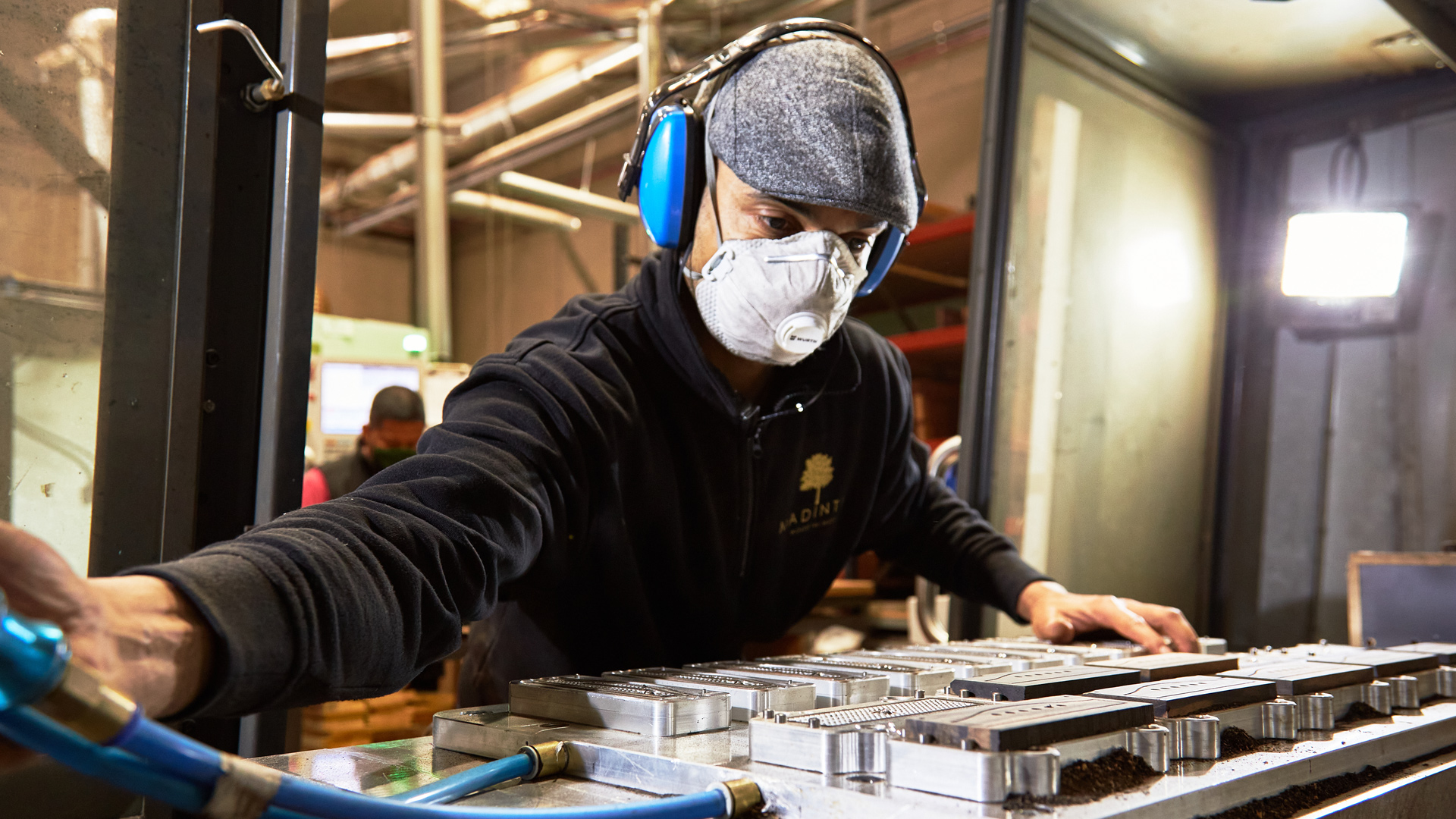
Our Spanish supply partner, Madinter, has grown into a respected name in the music industry and a passionate leader in ethical sourcing practices.

What could a veterinarian, a bartender and a dancer know about supplying wood to musical instrument makers?

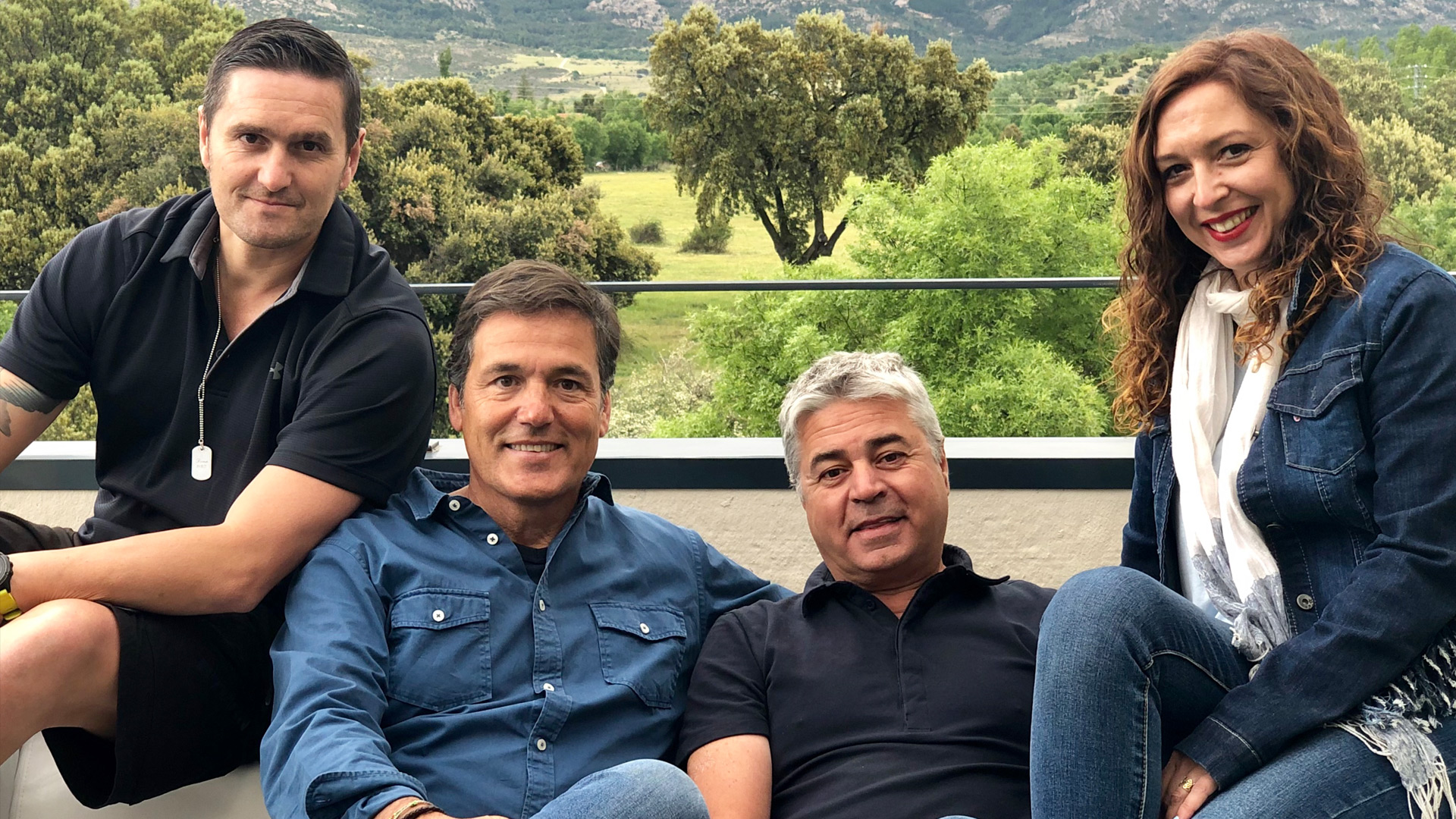
Actually, quite a lot, but 20 years ago, when their company, Madinter, was launched, there was still much to learn as each pivoted to a new career path together. Co-founder, CEO and majority owner Vidal de Teresa (the veterinarian), Production Manager Jorge Simons (the bartender) and Sales Manager Luisa Willsher (the dancer), along with co-founder and silent partner Miguel Ángel Sánchez, form the core management team for the company, which supplies tonewoods and finished parts to makers of musical instruments, including Taylor.

Madinter and its 20 employees are based in the Spanish town of Cerceda, located in the province of Madrid, Spain — about 45 minutes from the city center. You might recognize the name Madinter (a contraction of Madera, the Spanish word for wood, and International) from our reports on ebony in Cameroon, as Madinter is our ownership partner in the Crelicam ebony mill. That partnership, now in its tenth year, is a testament to the shared commitment both companies have made to ethical sourcing practices, and to creating more sustainable forest economies that support the livelihoods of the local communities involved in the sourcing supply chain.

Though a relatively small company, Madinter has grown in many ways over the past two decades, leading the way in raising the standards of sustainability, legality and responsibility among timber suppliers. To help celebrate the company’s 20th anniversary, we wanted to connect the Taylor community with our valued partner and spotlight the important role they play in supporting a vibrant global music community and responsible forest stewardship.

We chatted with Luisa and Vidal via email. They shared the personal journey that brought each of them to Madinter and reflected on the company’s ongoing evolution in pursuit of its vision.

Tell us a bit about the town of Cerceda, where you’re located.

Cerceda is a small village of about 2,500 people located in the mountains of Madrid, about 30 minutes from Madrid Barajas International Airport. We are next to Sierra de Guadarrama National Park, in the north of the province of Madrid, a unique location for its natural environment. The Sierra de Guadarrama is full of stunning places due to its beauty and its geological and biological richness. Here you will find immense coniferous forests, high mountain meadows, snowy landscapes, enormous rocky peaks, streams, waterfalls and glacial lakes, making up an environment of special natural value that is home to endemic species and some in danger of extinction in Spain.

What might people find interesting about the design of your facility? For example, one of your buildings has an interesting façade — it looks like an artistic interpretation of tree trunks.

Yes, it’s a unique façade made of corten steel with a patina, which imitates the silhouette of a coniferous forest, very similar to those we have in our surroundings. The pieces simulate tree trunks of wild pine, the most representative tree in the national park. We wanted to make a small tribute to our forests and to wood.

Our buildings have solar panels on their roofs to make our business more sustainable and minimize our carbon footprint. We also burn our sawdust in furnaces and use the heat for our kilns where we dry our wood and also to warm the buildings in the winter.

How was the company established?

Prior to the founding of Madinter, Miguel had a company that sold wood to guitar craftsmen and that also sold guitars, helping craftsmen export their guitars to other markets. In 2001, Miguel and Vidal founded Madinter, and Jorge and I joined the team shortly afterwards. Now Madinter specializes solely in producing and selling parts for musical instruments.

In 2003, Miguel left Madinter to become a silent partner and created another company dedicated to the manufacture of flamenco shoes, Calzado Senovilla. Due to his experience with guitar woods, he decided to use these same woods and incorporate them into the manufacture of the shoes. Today, these shoes have a great reputation and are worn by the best flamenco dancers all over the world.

Vidal, you were a veterinarian, so starting Madinter was quite a career change. What was your motivation?

In 2001, after 11 years as a veterinary surgeon, I sold my company and found myself at a personal crossroads. I loved my profession, which had always been my vocation, but I had other passions outside veterinary medicine. These included traveling, getting to know the rainforests, and starting a new business venture. The world of luthiery was not alien to me because when I was studying veterinary medicine in Paris, Miguel would send me wood, and when I had time between my studies and practice at the veterinary school, I would visit luthiers and offer them these woods. This brought me extra money and allowed me to discover the exciting world of wood, guitar makers and music.

The great master luthier Daniel Friederich was my first customer. I went into his workshop in the Faubourg Saint-Antoine district, near the Bastille in Paris. He was carrying a handful of sets of rosewood sides and backs. I was an inexperienced young man, but very curious. He took exquisite care of me and showed me the nooks and crannies of his workshop and instructed me on the wood I was carrying. It was a fairy-tale workshop, full of wood aromas and shavings, of guitars in the process of construction. That day I became interested in learning more about that trade, about those woods, where they came from, how they were cut, how they were dried. That was the seed that ignited a passion in me and made me change my career years later and start an exciting new story.

Luisa, you’re originally from the UK and studied dance. How did you get involved with Madinter?

I was born and raised in England, and at 10 years old I went to a performing arts boarding school until I was 18. We were trained mainly as ballet dancers but also studied other dance genres, and I immediately fell in love with flamenco. After visiting Spain a few times for short dance courses, at 18, I was offered my first job and moved to Spain knowing that I would never return to England for good. At 24 years old, while rehearsing, I broke my foot. By this time, Madinter was taking its first baby steps with Vidal, Miguel and Jorge, and to keep myself occupied, I helped them out, translating and writing to clients. Back then all correspondence was by letter or by fax. We bought our domain, www.madinter.com, started writing emails, set up our first web page, and began our continuous improvement. By the time my foot was healed and I could have gone back to dancing, I was so involved and enjoying the work I was developing at Madinter I never left. Now the only dancing I do is for fun.
Your range of products and services has expanded a lot over the years after starting exclusively as a wood supplier. How has your business evolved?

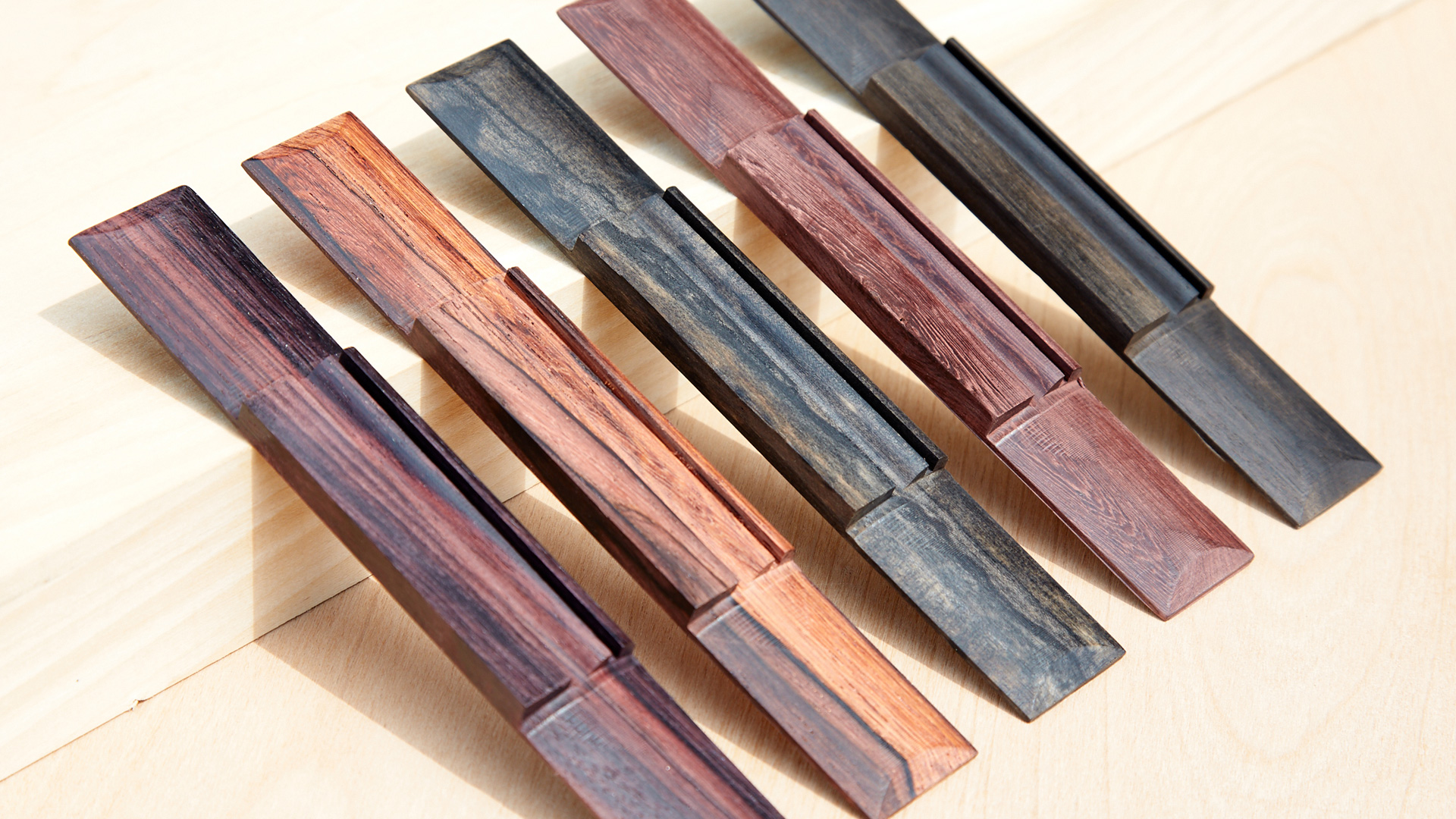
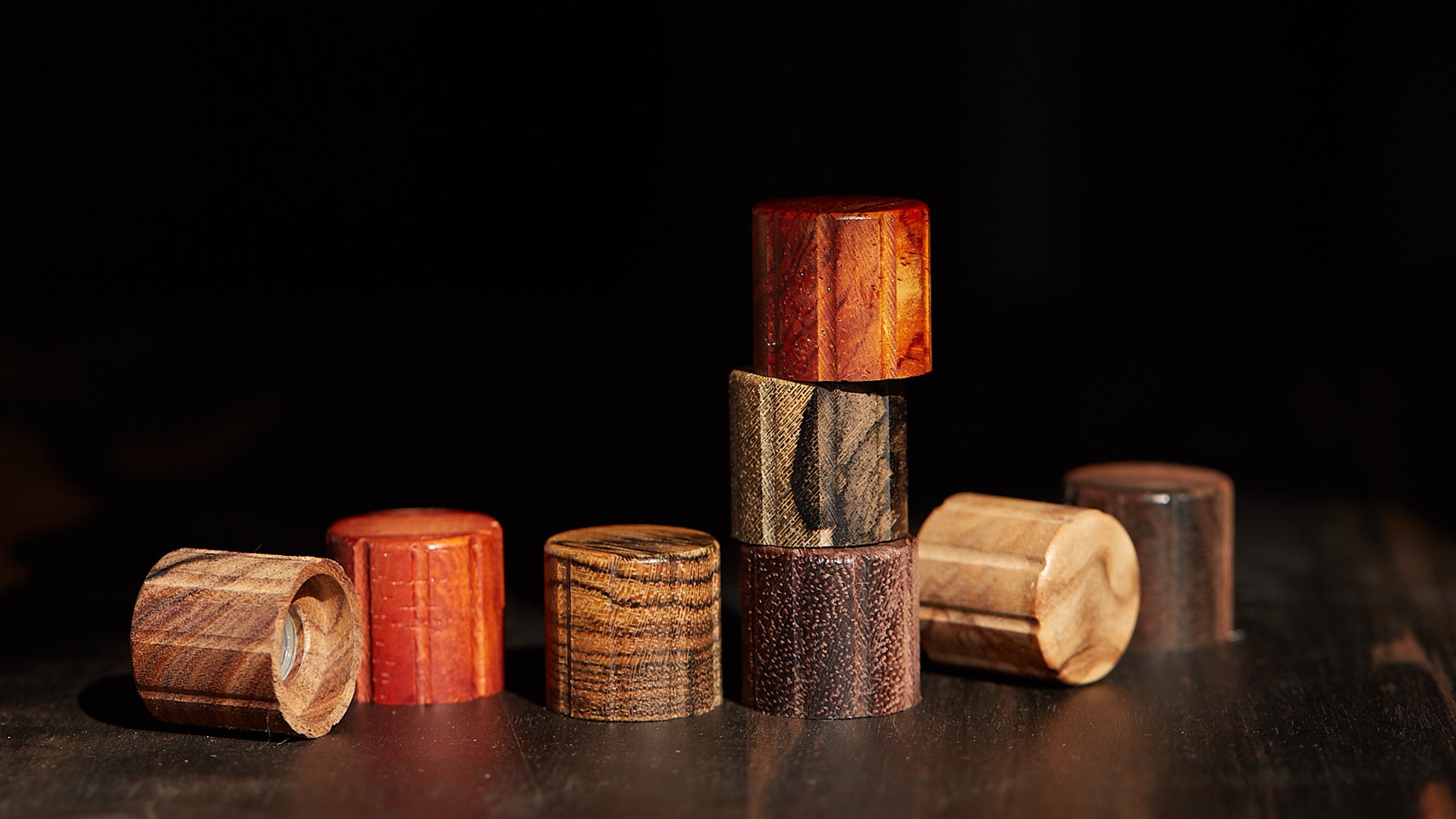
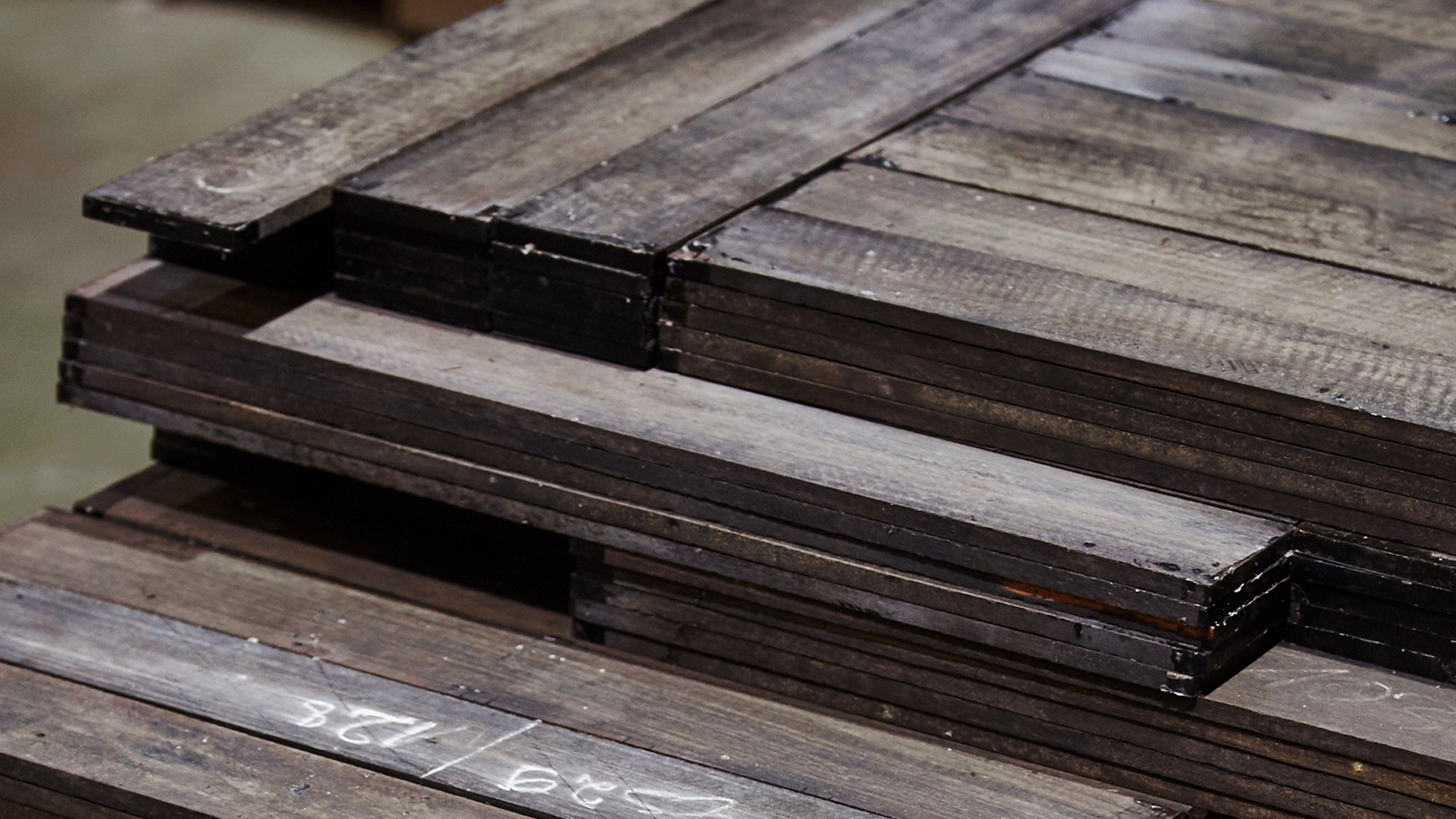
In the beginning, we only supplied wood to musical instrument manufacturers. We started with half a dozen species of wood. Today we offer more than 40 different species for making musical instruments, especially guitars, and we also supply components, accessories and tools. We have also become more specialized in manufacturing finished musical instrument parts using unique and precise machinery, enabling us to add more value to the raw material. As a result, our business model has changed a lot in recent years. We no longer only supply musical instrument manufacturers, but also the craftsman and the hobbyist instrument maker. Our website has become a resource hub in the industry because we offer a large range of products and solutions. We cut the wood, dry it, process it, make finished parts ready to assemble instruments, and we also manufacture customized products for several clients. We work with factories, workshops and makers all over the world. And for three years now, we have been distributing StewMac products in Europe, and we are their sole distributor apart from themselves.

“Over the last 10 years, we have seen many new young guitar makers or even amateurs who are attracted by the do-it-yourself culture and are starting to build instruments.”

Spain has such a rich guitar-making heritage, and as I understand it, there currently are many luthiers there. Can you provide some perspective on that and how it impacts your business?

Spain is a country with a great tradition in classical and flamenco guitar making. We have a lot of guitar makers and very good ones. Over the last 10 years or so, we have seen many new young guitar makers or even amateurs who are attracted by the do-it-yourself culture and are starting to build instruments. Many of them are attracted because they are musicians and would like to know how to make the instrument they play, and others because they have a knowledge of cabinetmaking and would like to learn how to make guitars and diversify their activity. In any case, the determining factor in this explosion of new luthiers is Madinter and similar companies that have supplied a wide variety of products to the market, making it possible to find everything needed to build a musical instrument, from materials and finished products to all kinds of components, accessories and luthier tools. There are also many luthiers all over Europe, and through Madinter.com we can reach all of them. Our customer base has diversified enormously and continues to grow month by month.

Luisa, in a previous email you said that one of Madinter’s keys to success has been the ability to adapt to change. Can you elaborate on this in any specific ways? One thought that comes to mind is the way legal compliance requirements have changed over the past two decades with regulations like the amendment to the Lacey Act or changes in the status of certain wood species with CITES or EU timber legislation.

We have adapted to change in many ways over the last 20 years, but one key factor was indeed our decision to focus on legality. When the Lacey Act was amended to include musical instruments, Madinter was already emphasizing the importance of our wood being legally and responsibly sourced. So when the industry realized that they too needed to make sure that they were purchasing legal wood, Madinter had a solid due diligence system in place and vast knowledge of compliance, CITES, etc.

Some other examples: In our early years we set up our first online store at Madinter.com, which no others had. We visited Asia and started offering solid wood to Chinese factories before any of them even made solid-wood guitars! We also broadened our catalogue to meet our clients’ needs and diversify our business. We added components, accessories and tools, and we are very proud that StewMac trusts Madinter to be their sole distributor other than themselves.

Also, new luthiers were no longer the sons of the older generations. They were newcomers learning the trade, so we started to offer guitar-making courses.

Take a video tour inside Madinter’s wood processing facilities in Cerceda, Spain.

In addition to your range of products and services, what do you think sets you apart from other companies?

Our vision as a company is to lead the music industry in championing a sustainable forest economy by maintaining the highest standards of sustainability, legality and responsibility in our timber sourcing. Right from the start, we decided that we did not want to be another company just cutting down trees. We wanted to do things correctly. To start with, we wanted to make sure every single piece of wood was sourced legally, complying with all national and international laws. This should be obvious and standard, but unfortunately it is not. And then go a step further and make sure that the environment, the people, are not being harmed, and if we can, to have a positive impact on the world.

It’s not only Madinter’s 20th anniversary this year, but also the tenth year of Madinter and Taylor’s Crelicam partnership. How would you reflect on what our two companies have managed to accomplish so far and what it means for Crelicam employees and other sawyers and supply partners in Cameroon?

We are very proud of this partnership and how much we have achieved together. In just 10 years, we have changed many things and always for the better. When we acquired Crelicam and designed the logo, we also added a slogan that we have stuck to: Responsible Trade. Looking back at what we have achieved together, we are very pleased. Together we have managed to get the industry to accept the ebony that it did not use before because it was too light in color; we have improved the living conditions of our workers, collaborators and the people who live around the factory; and we have improved the health, technological conditions and professional qualifications of our employees. And as the cherry on top, we have launched the Ebony Project in order to plant and perpetuate the use of ebony for future generations.

During these years, we have also received recognition from the music industry and from the governments of the U.S., Spain and the EU, which have awarded and publicly acknowledged our work in Africa. But the most important thing is that this is not over. We still have many ideas, projects and improvements that we want to implement in the years to come.

What do you value about your relationship with Taylor?

Often, we recall the first time we proposed the Crelicam acquisition to Bob [Taylor] and how he welcomed the idea and his enthusiasm from the very beginning.

In 2010 we went to Amsterdam because we knew that Bob, Kurt and CFO Barbara Wight were meeting in the Netherlands with their European distribution team. We called Bob a few days in advance and told him we wanted to present him with a business proposal. We had spent weeks working on an elaborate business plan and had a long presentation to make with a lot of ideas and numbers. When we arrived at the hotel where Bob was staying and introduced the idea to him, he immediately cut the presentation short and said, “I like the idea, and we are going to do it together.” Half an hour later, together with Bob, Kurt and Barbara, we were planning our first trip to Cameroon. And so began this wonderful adventure.

Working with Taylor Guitars has been the best thing that has happened to us over the last few years. We have found a group of fantastic professionals and wonderful people. A special mention must go to our great friend and mentor, Bob Taylor — a wonderful person with a big heart, with unique intelligence and brilliance, a tireless worker as well as a visionary in the music industry. We have learned together and made mistakes together, but we have always moved forward and will continue to move forward toward excellence.
Growing in Place

Scroll Down

How artists found inspiration in isolation by looking inward

Though the COVID pandemic may have temporarily emptied music venues, it’s hardly kept musicians quiet. During the isolation, the digital world exploded with creativity as artists adopted an array of tools that allowed them to stay connected with fans, make new music across distances, and collaborate with other musicians they never would have met otherwise. Some focused on keeping live music available for fans, staging livestreamed performances that ranged from elaborate, professionally filmed productions to simple bedroom jam sessions. Others focused on craft, exploring new musical territory and writing songs that reflected the pressures of the moment. Still others found the pandemic a time for personal reflection, an opportunity to reexamine life and grow a stronger sense of personal and musical identity.

Photo credit above: Ivan Pierre Aguirre

In places where public life is reopening and live music is returning, artists have begun to resume the pursuit of their musical calling. But to those preparing to hit the road again, it’s clear that things have changed — the world of music feels different, as do performing and writing. And as musicians find stages and begin filling seats with fans, many are doing so with new ideas about what makes a good show, a great song and a strong connection with an audience, along with a new appreciation for what they do and a fresh gratitude for the spaces in our culture that foster music as a force of community.

Digital Natives Meet the Real World

Of all the consequences the music world experienced due to the pandemic, one of the most lasting is how it threw a spotlight on underexposed musical spaces as brick-and-mortar venues put business on hold. In our story on the livestreaming boom from the previous issue of Wood&Steel, artists told us about the newfound power of digital tools that connect musicians to audiences across physical distance and restrictions on public life. Livestreaming helped keep artists in the swing of performing, even if that meant sitting in front of an iPhone camera with just an acoustic guitar as fans tapped out their digital reactions in the form of smile emojis and hearts. That development has largely been a positive one for all sorts of musicians, and those with a strong foundation in social media had an even greater advantage as fans looked online for their live music fix.

It hasn’t always been this way. Major touring acts and established musicians have long held sway on the attention of the music-listening public, even as tools like YouTube, SoundCloud and BandCamp grew in popularity with artists who had yet to break into the industry. In the pre-COVID world, artists who made their bona fides in the “real world” carried an air of authenticity and quality that “online” artists simply couldn’t match. In a way, the tools that were supposed to democratize music-making ended up pigeonholing young, creative and diverse musicians into an online arena populated by relatively small numbers of dedicated fans. The passion was there, but the exposure was not.

The pandemic changed all of that. With major artists and up-and-comers alike forced off physical stages and onto the Internet, the music of the digital world found itself on a level playing field for the first time. What resulted was an explosion of bands, songwriters and solo musicians into the public eye, many of them from backgrounds rarely showcased in the musical mainstream.

Meet Me in the Living Room

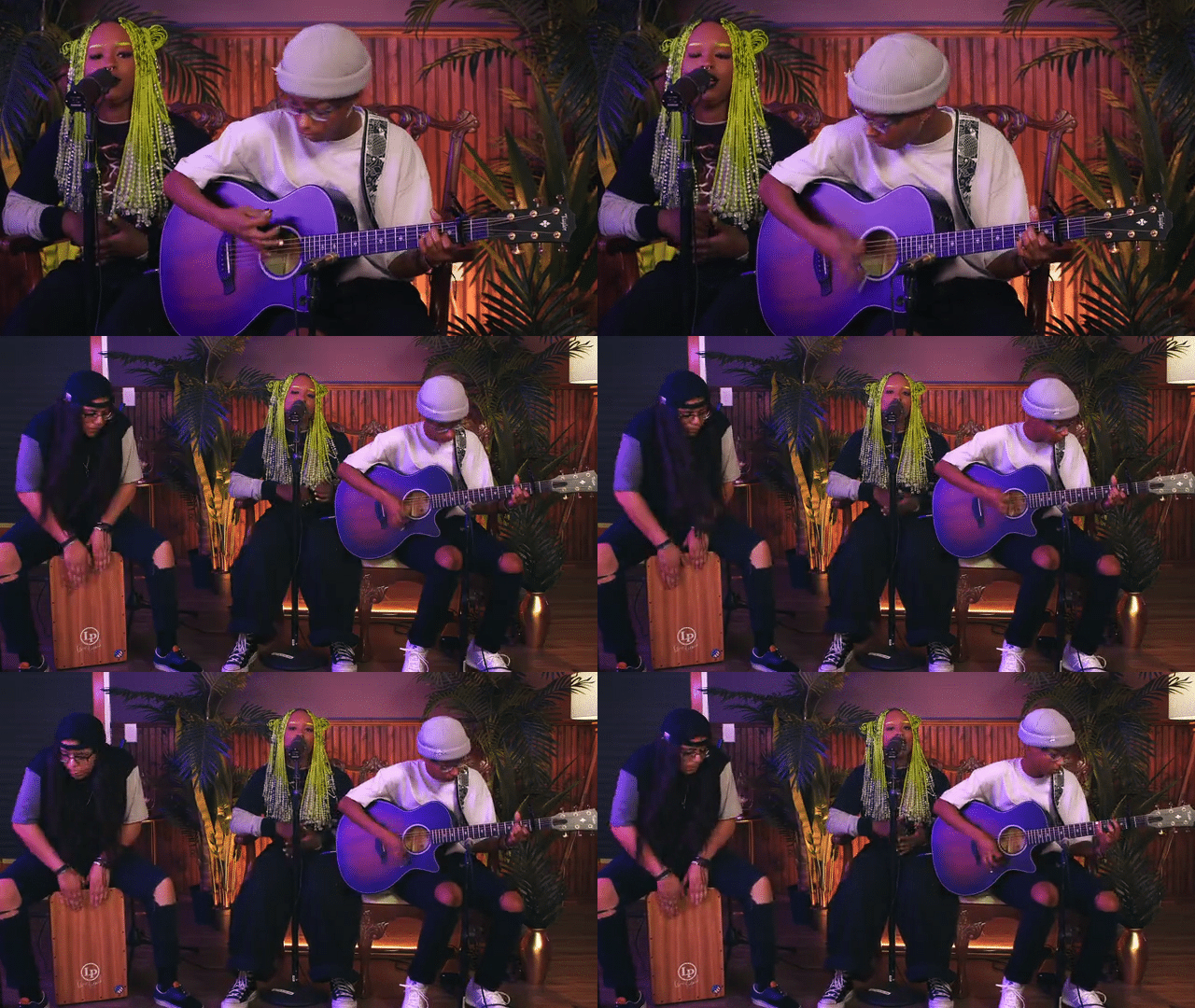
Of the many artists that managed to capitalize on the conditions of the pandemic months, pop-punk newcomers Meet Me @ The Altar have blazed a particularly exciting trail. The trio of Téa Campbell (guitar, bass, 224ce-K DLX), Ada Juarez (drums) and Edith Johnson (lead vocals) have been making music together since 2017, but perhaps not in the sense you might expect. Until this year, the three musicians wrote and produced their songs over distances, sending ideas, lyrics and instrument parts back and forth over the Internet until they arrived at a finished product. Suddenly, their way of writing music became the norm, and as musicians everywhere adjusted to this siloed style of creation, Meet Me @ The Altar found themselves with an enormous head start.

“We were an Internet band for like five years,” Téa says. “I lived in Florida, Edith lived in Atlanta, and Ada lived in New Jersey, so we had never really written songs in the same room before.”

Though they moved into a house together during the pandemic, the members of Meet Me @ the Altar say their writing process barely changed as a result of their proximity.

“Even though we moved in together,” Ada says, “this way worked before, so why would we try to change something that was working? So we still write in our separate rooms and then come together. We write lyrics in the same room now, but otherwise it’s the same as before.”

Ada, Edith and Téa from Meet Me @ the Altar talk about their experience of making music during the pandemic and play acoustic versions of their songs.

The “Internet band” effect made an impact beyond the songwriting process, too. With plenty of experience navigating the digital realm and engaging with fans over the web, COVID helped set the conditions for the band’s dramatic spike in recognition. The trio had planned to start touring in 2020 and 2021 — instead, they wound up at home, where writing songs was essentially the only creative outlet. Stripping away the “traditional” elements of the music industry had a way of making artists refocus on the essence of their craft. For these three, the pandemic was a pressure cooker that helped them grow in both skill and confidence.
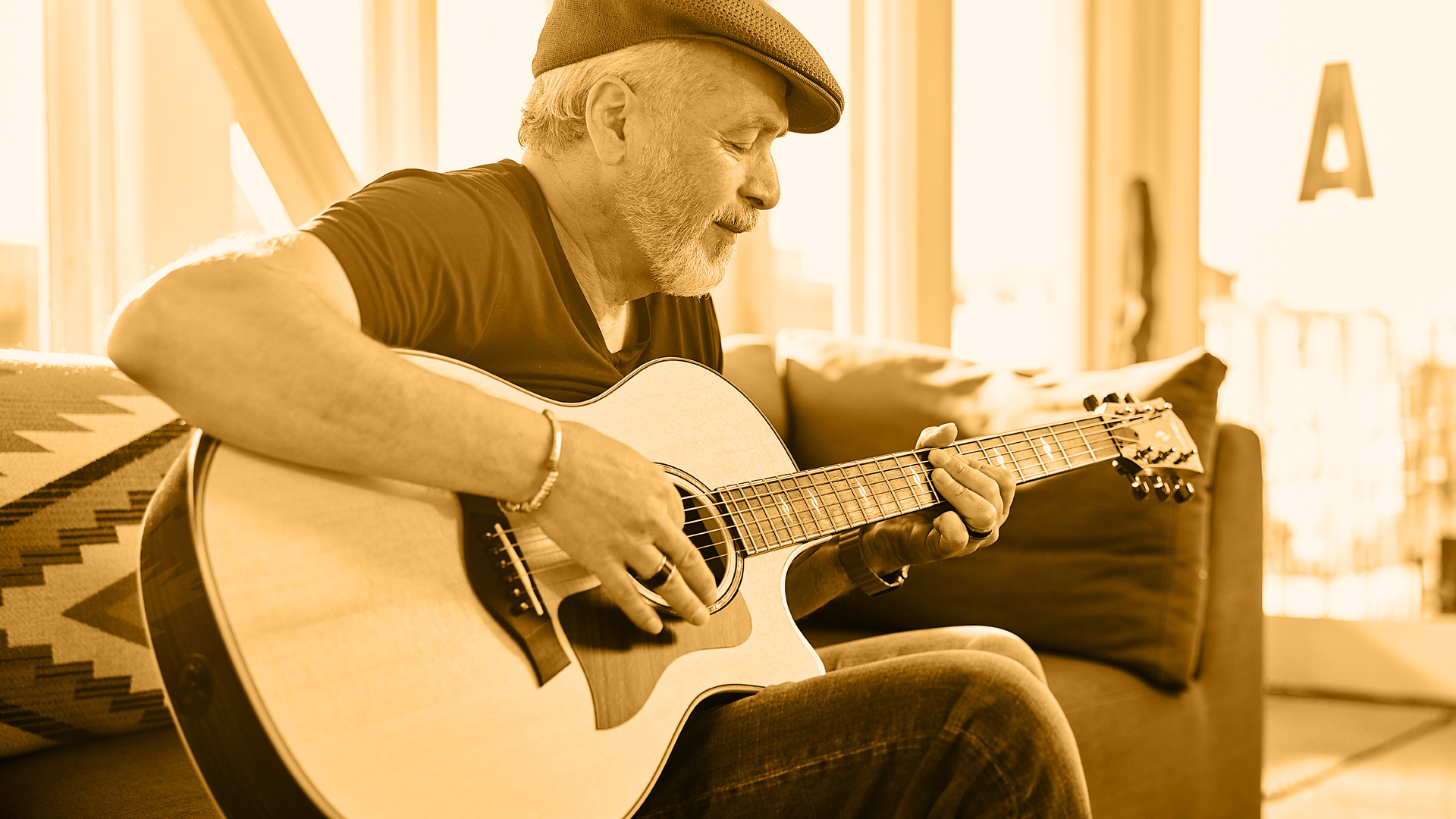
“Quarantine changed a lot for us,” Téa recalls. “If it weren’t for quarantine, we wouldn’t really have had time to sit and think about the direction we want to go and how we want to evolve as a band.”

Instead of touring, Meet Me @ The Altar doubled down on songwriting. Instead of livestreaming, as so many artists did during isolation, they wrote. Save for a streamed show in partnership with Wendy’s restaurants, Meet Me @ The Altar looked to each other, focusing on shaping their voice and developing an identity as musicians.

“The more you write, the more comfortable you feel,” Edith says. “Quarantine was a blessing in disguise. It helped us come together, and we matured through our songwriting. Now, everything we write tops what we did before.”

The work paid off. The band says they blew up during the pandemic, going from 3,000 followers to over 50,000. Though it’s a bit strange not being able to actually see that growth in the form of bigger audiences at shows, their connections with fans online has helped them get a better sense of where they fit into pop culture in general. They credit some of their growth to a changing society and evolving attitudes that increasingly demand greater inclusion of women musicians and artists of color. As a trio of women of color, Meet Me @ The Altar found their moment.

“A lot of things were happening during quarantine — social issues, Black Lives Matter, George Floyd’s death,” Edith says. “But since people really couldn’t do much, they really had time to think about the world. People started thinking about Black life and Black art. We were right there, and since our music is actually good, people stayed.”

By zigging where others zagged during the pandemic, Meet Me @ The Altar found a perfect opportunity to build on their success and follow their explosion of popularity with improved songwriting and a better sense of identity as a band. But not all of today’s musicians were born into the digital ecosystem. For those who have put decades into a more traditional approach, the pandemic represented a different challenge: How do you adapt to the times without losing yourself?

Turning Music into Community

Closed venues and cancelled shows were the most obvious signs of trouble within the music industry during the pandemic, but another challenge had a quieter, but no less significant effect: mental health. Isolation, unprecedented economic pressure and ongoing social change put a strain on many over the past 18 months, including artists whose primary source of emotional, social and creative catharsis — not to mention financial stability — was dramatically cut off without warning. For former At the Drive-In co-founder, current Sparta guitarist and longtime solo songwriter Jim Ward, holding on to music through the pandemic was about more than maintaining a public profile and keeping fans engaged online: It was about survival.

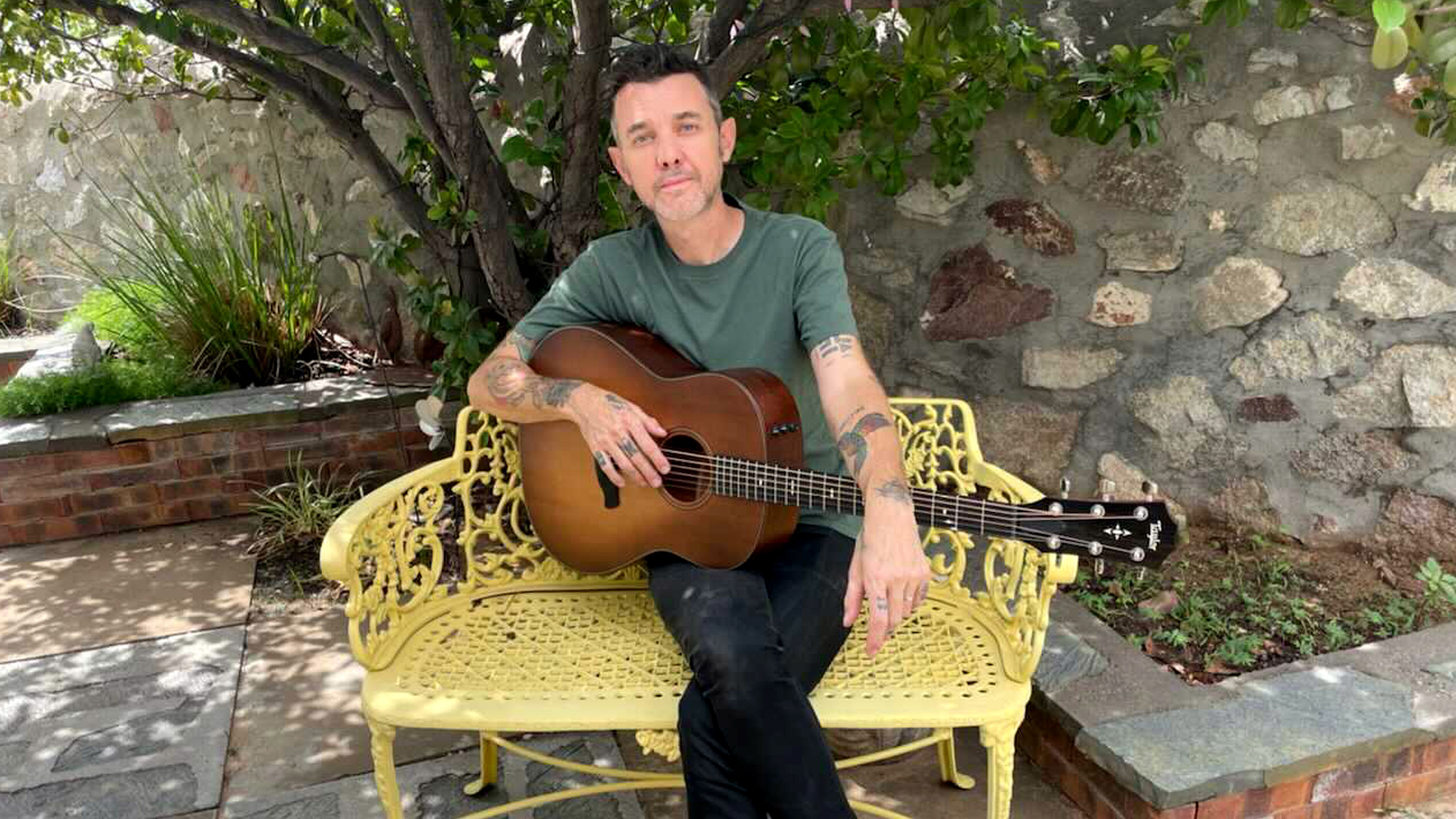
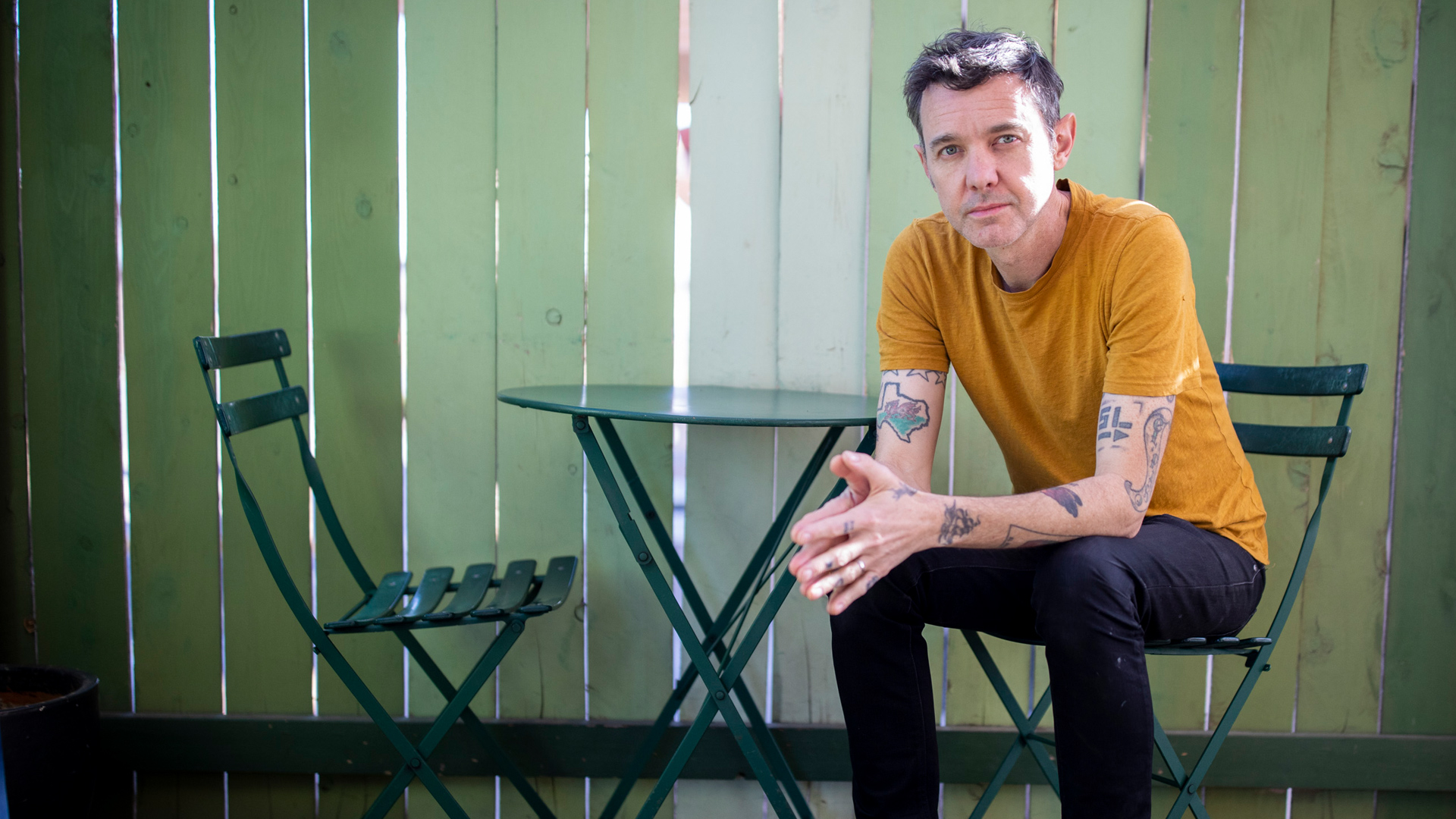
Ward (Builder’s Edition 517, GT Urban Ash) is a fixture in his home town of El Paso, Texas. He’s deeply connected to the city, its music scene and even its food culture — Ward owns a restaurant in El Paso that was forced to close during the pandemic. As a person naturally drawn to community, Ward says that the events of the early pandemic were devastating, both for him and the people around him.

“We immediately had to lay people off,” Ward explains, “which is hard emotionally and mentally. My band, Sparta, had a record that came out in April [of 2020], and I like to say it came out to crickets. We canceled tours and had to furlough crew like everyone else.”

Without the natural outlet that creative work provides, Ward says, he struggled through the early days of the pandemic.

“Lockdown is hard on you as a human being,” Ward says, “especially if you’re a social human being. It was hard to stay good in the head.”

Guitarist and songwriter Jim Ward shares his thoughts on persevering through the pandemic and maintaining his mental health during isolation.

Despite the restrictions on public spaces, Ward knew that keeping his head right meant keeping up with music. Turning to songwriting, Ward distracted himself with a new set of songs that would become Daggers, his latest solo album. Writing and creating the album was a kind of therapy, he says, one that both helped him manage his mental state and expand his creative abilities.

“I’ve definitely grown as an engineer, because I was forced to engineer and produce the album myself, where normally I would have relied on other people,” he says. “When the tools that make your job easier disappear, you’re forced to learn new things. I came out of it with a renewed DIY ethos in my life.”

But self-reliance only goes so far. Learning new musical skills is one thing, but it’s not a substitute for human interaction and connection, especially for someone as involved in the community as Jim Ward. In the absence of chances to meet and greet fans at shows, Ward found himself forging relationships with fans online, often fans he would never have had a chance to meet otherwise. And it didn’t stop with Instagram conversations with fans as scattered as Australia and Moscow. Soon, the drive to preserve some sense of togetherness led Ward to start a new tradition: Friday Beers, a series of live, unrehearsed, unedited conversations hosted on Instagram between Ward and another musical guest. So far, Friday Beers has included talks with Rhett Miller, Nina Diaz, the Black Keys’ Patrick Carney and Josh Homme from Queens of the Stone Age.

These aren’t your run-of-the-mill artist interviews focused on new albums, upcoming shows and songwriting inspiration — they’re thoughtful, often profound discussions that see Ward and his guests opening up for audiences on a personal level in a way that isn’t possible with the few minutes of face time artists are able to give fans at gigs. Ward says that these conversations have been revelatory, not just for how they helped him get through isolation, but for how they helped audiences as well.

“Josh Homme is like an older brother to me, and we had this really deep, personal conversation in front of all these people,” Ward recalls, “and I got all these really beautiful messages from people saying things like, ‘This is how male relationships should be.’ The truth is, a lot of us make music because we’re trying to figure out how to feel better. And when you start having those conversations, people can say, ‘If that guy feels like this, it must be OK that I feel like that, too.’”

Ward sees this as a feature of the pandemic that should stick around as life returns to something like normalcy. In a world that has grown far too used to seeing its young artists spiral out of control, there’s something special about creating spaces that encourage honesty and authenticity. On that subject, Ward speaks from personal experience.
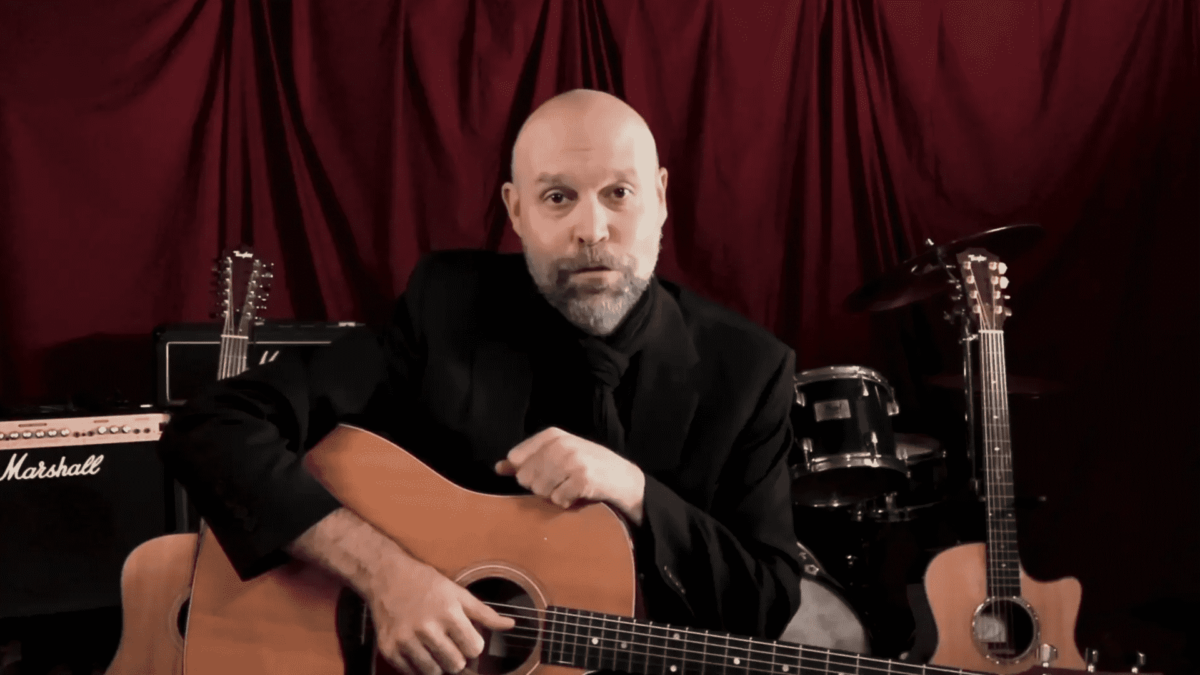
“I honestly believe the early part of my career would have benefited from someone saying, ‘It’s OK to not feel good right now,’” he says. “Instead of just handing you a bottle of vodka. We could do better at taking care of our young artists that way.”

No Right Way to Make Music

The landscape of today’s music world is ever-evolving, fueled in equal parts by changing social attitudes, the growing accessibility of new music outside the traditional record label pipeline, and the tangible consequences of a global health crisis. Seasoned insiders and emerging artists alike are finding that in these times, building or maintaining a career in music means being willing to look inward — to focus on craft, to dig deep and explore uncharted creative territory. Though today’s digital tools make it easy to connect with audiences and individual fans, they cannot replace the hard work of transforming ideas into actual music, of offering a message that is both authentic to oneself and universal enough to inspire listeners around the world. Fortunately, if the pandemic has revealed anything about contemporary music and the people who make it, it’s that the drive to create persists regardless of circumstance.

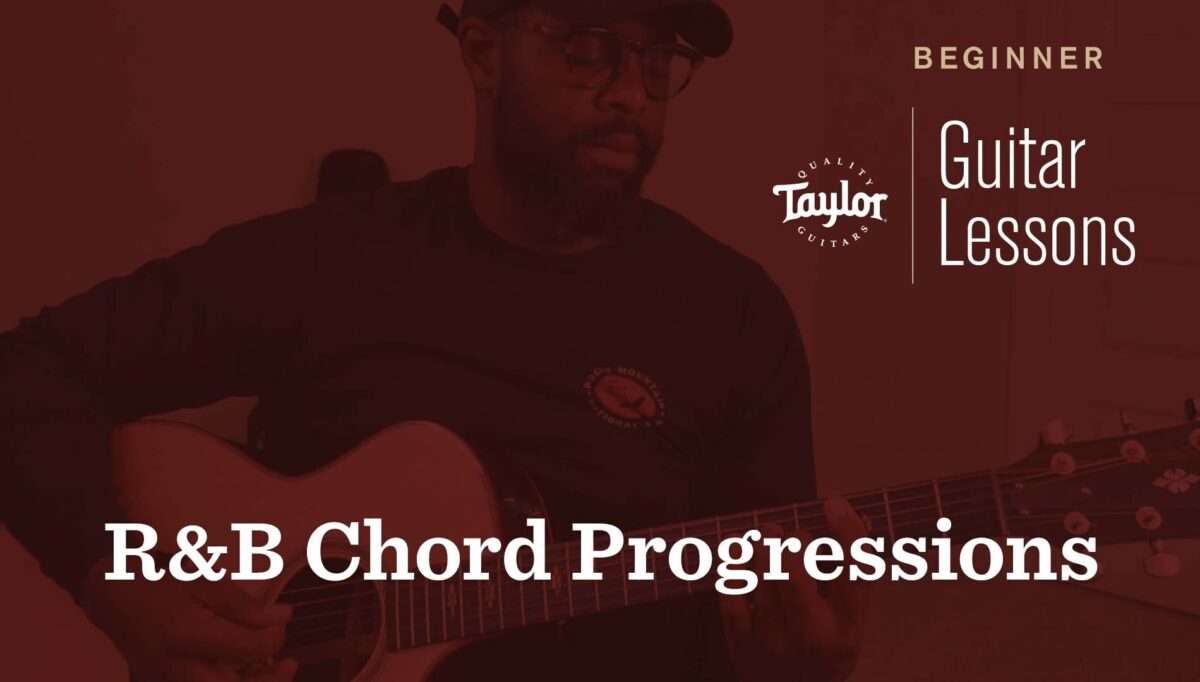
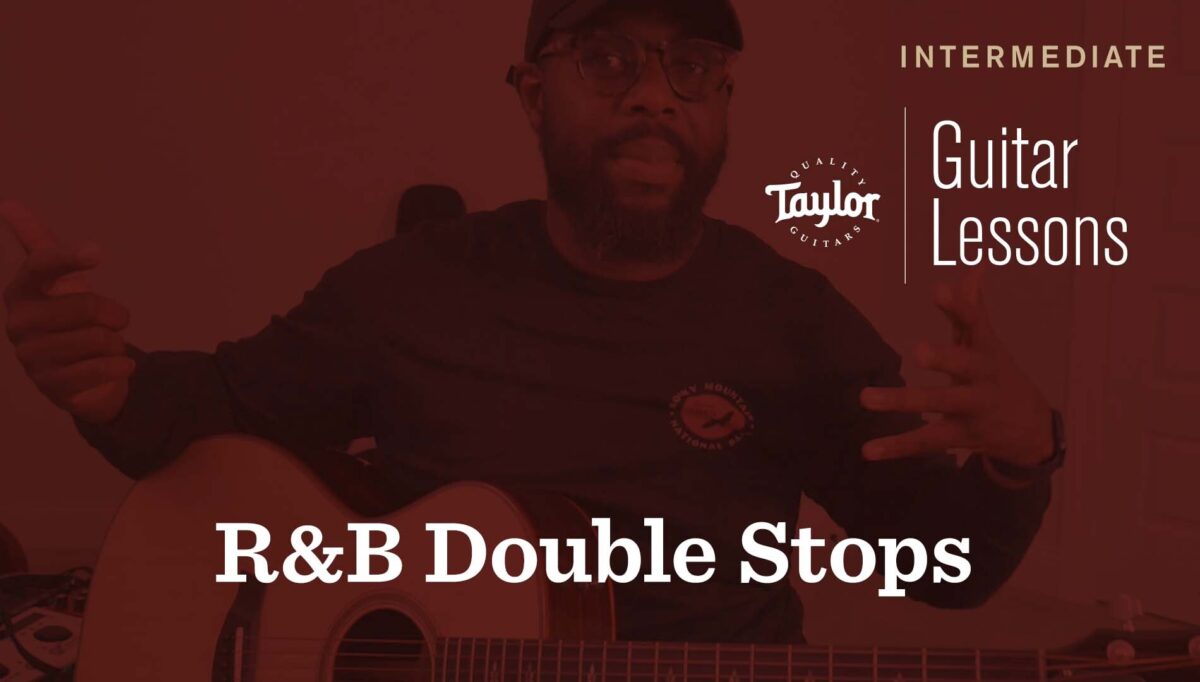
R&B Chord Progressions for Acoustic Guitar

Scroll Down

Expand your stylistic repertoire with these handy chord progressions commonly used by R&B guitarists.

By Kerry "2 Smooth" Marshall

Whatever your preferred style or genre, learning new sounds and techniques outside your comfort zone is essential for becoming a well-rounded guitar player.

Kerry “2 Smooth” Marshall is an in-demand music educator, session guitarist, producer and guitar teacher who specializes in R&B, neo-soul and gospel music. In addition to playing alongside some of today’s top musical acts, he’s also a mainstay on YouTube, where he’s reached over 100,000 subscribers.

The first lesson reviews a common chord progression that will help you get started with R&B styles.

Next, Kerry explains the double-stop technique, a common sonic element that R&B guitarists use to add dimension to their licks.

Finally, Kerry explores the diminished 7th chord, a distinctive sound that will enhance your sound and add a new flavor to your style.
You can find more lessons from Kerry on his YouTube channel.

  • 2021 Issue 2 /
  • Deep Roots: The National Museum of African American Music

Deep Roots: The National Museum of African American Music

Scroll Down

In honor of African-American Music Appreciation Month, Taylor’s Lindsay Love-Bivens and GRAMMY-winning artist Judith Hill visited the newly opened Nashville museum, which celebrates the pioneering influence of African-American artists on American music genres.

Nearly every genre of American music can be traced back to the creative ingenuity and artistic expression of African-American artists. With a tapestry of lived, shared experiences woven throughout different eras, African Americans originated and shaped musical styles from the blues to hip-hop, helping to spawn many other musical cross-pollinations in between. African-American Music Appreciation Month, observed in June each year, gives us an opportunity to illuminate those essential contributions and reacquaint ourselves with some of the people responsible for the music that forms the soundtrack to life in America and around the world today.

What is African-American Music Appreciation Month?  

In the 1970s, prompted by the increasingly prolific influence of African-American artists during the 20th century, a movement led by key members of the African-American music community to recognize these artists gained traction. In 1978, producer Kenny Gamble, influential music activist and broadcaster Dyana Williams, and broadcast executive Ed Wright launched the Black Music Association (BMA) in part to push for the creation of a Black Music Month. After some petitioning, U.S. President Jimmy Carter hosted the first Black Music Month gathering in the summer of 1979. In 2000, President Bill Clinton signed a Presidential Proclamation giving African-American Music Appreciation Month national designation. These actions helped ensure that the story of African-American music would be preserved and honored for generations to come.

A Trip to Nashville 

To celebrate African-American Music Appreciation Month, I traveled to Nashville with singer-songwriter and Taylor artist Judith Hill to tour the brand-new National Museum of African American Music. While there, we spoke with Dr. Steven Lewis, one of the curators of the museum. We also spent time visiting historical sites related to the history of African-American music. The video we put together shares some highlights of our experiences there.

A Timeline of African-American Music 

Our trip also inspired us to create a timeline of the history of African-American music in an effort to shed more light on some of the African-American musical pioneers whose artistry forever changed the musical landscape in America and beyond. While our timeline barely scratches the surface of such a rich and deep musical heritage, we hope this historical journey invites a deeper exploration of the many ways in which African-American musicians shaped much of what we now know as American music.  

Originated in

17th Century

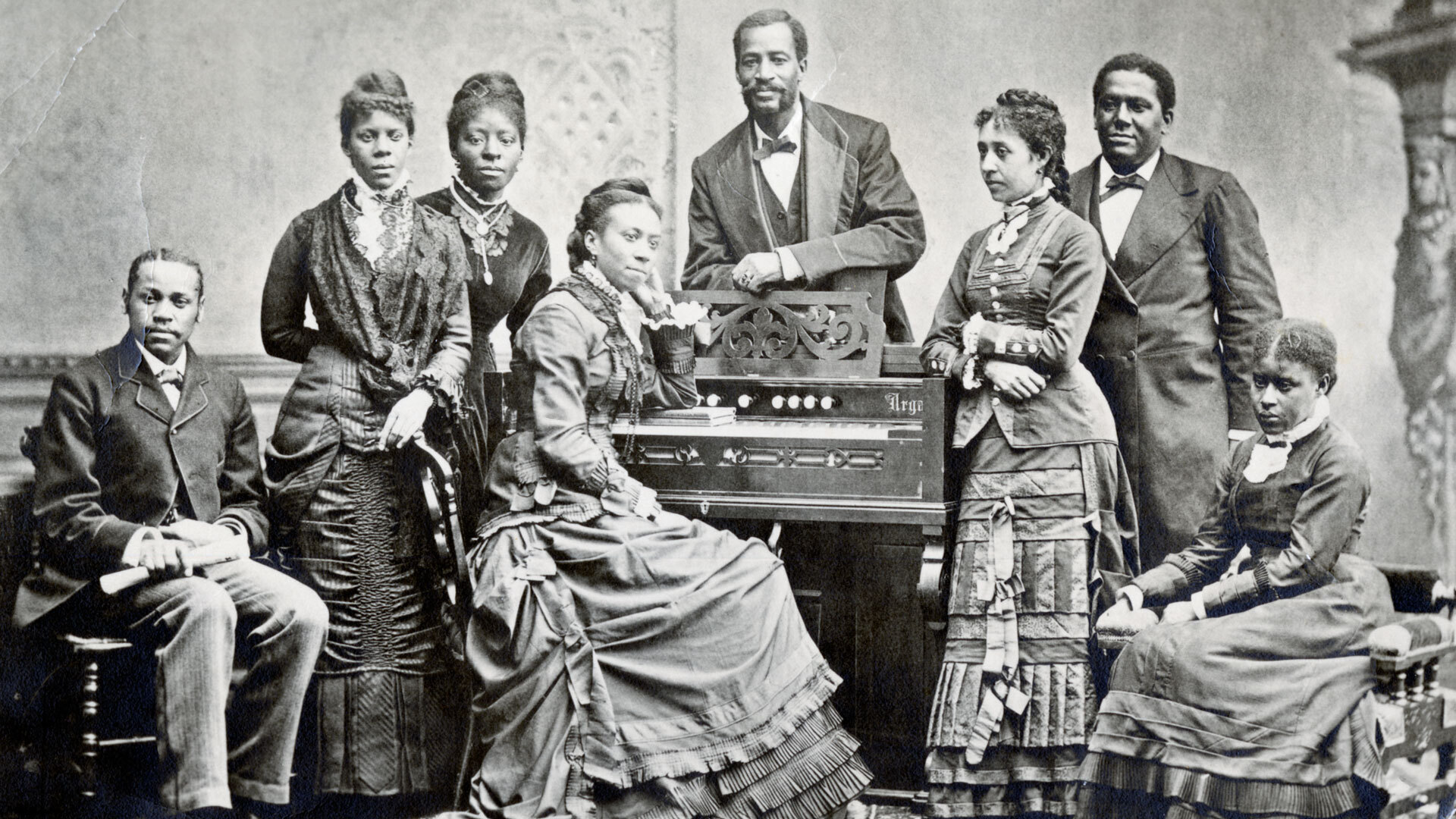
The earliest form of Black musical expression in America, spirituals include African-American work songs that wielded a powerful influence on the blues and gospel music later. Spirituals were rooted in biblical stories but represented the severe hardships endured by African-Americans who were enslaved from the 17th century to the 1860s. The “call-and-response” exchange is a prominent feature of spirituals—that is, when a leader sings a phrase and the rest of the group responds with the same or different phrase. Originating from traditional African songs, call-and-response is a key component of African-American work songs and eventually found its way beyond spirituals and into blues, gospel, rock ‘n’ roll, soul and even hip-hop music. Spirituals were popularized by groups like the Fisk Jubilee Singers beginning in the late 1800s.

Pioneers and Trailblazers

  • Fisk Jubilee Singers  
  • Hampton Singers 
  • Tuskegee Institute Quartet 
  • Harry Burleigh 
  • Everett McCorvey

Originated in

Late 1800s

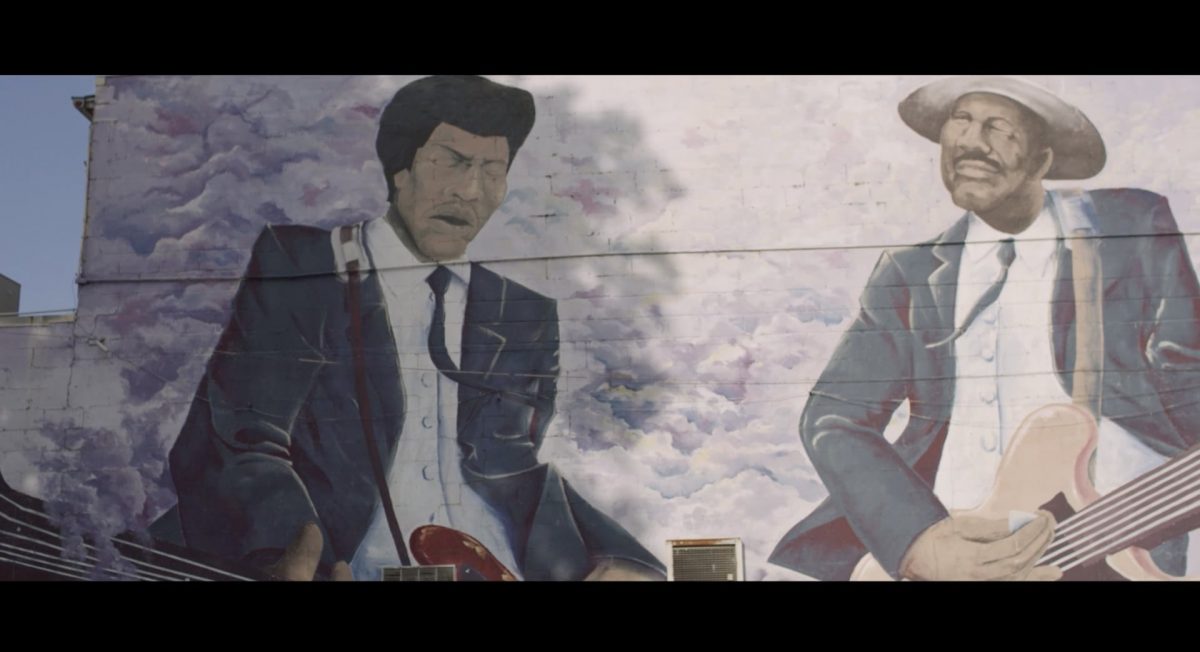
The blues originated in the deep south of the United States in the 1860s. Built on African-American spirituals and work songs, the blues prominently feature the call-and-response style shaped by spirituals, along with shouts and the distinct blues scale and chord progression that remain central to the blues sound today. It became popular as a musical form after the enslavement of African-Americans ended and aided in the establishment of the “juke joint,” an important facet of African-American culture that arose across the South to cater to formerly enslaved people seeking work. Almost every genre of American music has been influenced by the blues at one point or another.

Pioneers and Trailblazers

  • Charley Patton  
  • W.C Handy 
  • Blind Blake 
  • Lonnie Johnson 
  • Ma Rainey 
  • Robert Johnson 
  • Muddy Waters 
  • T-Bone Walker 
  • Blind Lemon Jefferson 
  • B.B. King 

Originated in

1890s

Ragtime is instantly identified by its distinctively syncopated musical style. Before it was released as popular sheet music for piano, ragtime provided dance music in popular music settings. Minstrel show tunes, African-American banjo styles, the syncopated (off-beat) dance rhythms of the cakewalk, and elements of classical music all contributed to the genesis of this trailblazing genre. Scott Joplin, one of the best-known ragtime composers today, published “Maple Leaf Rag” in 1899, which became a standard in American music and served as the foundation for ragtime music by composers who followed. Ragtime helped shape jazz and the blues, and was arguably the first branch of African-American music to make an impact on mainstream popular culture.

Pioneers and Trailblazers

  • Ernest Hogan  
  • Scott Joplin, “King of Ragtime” 
  • Tom Turpin 
  • Eubie Blake 
  • John William “Blind” Boone 
  • Antonio Junius “Tony” Jackson 
  • Ferdinand “Jelly Roll” Morton 

Originated in

1910s

On the heels of ragtime, a new genre was born in New Orleans, Louisiana: jazz. Complex chords, polyrhythms, syncopation and many more elements from blues and ragtime can be found in jazz. Though many would say the genre is impossible to define, improvisation is a central element across most jazz styles. From bebop and swing to modal and smooth, jazz embraces the personal interpretation and creativity of the performer. Jazz became increasingly popular in the 1920s, later known as the “Jazz Age,” a period when African-American music and culture began to reach the white middle class across America.

Pioneers and Trailblazers

  • Ferdinand “Jelly Roll” Morton
  • Louis Armstrong 
  • Earl Hines
  • Miles Davis
  • Duke Ellington
  • Charlie Christian
  • Lonnie Johnson 
  • Billie Holiday 
  • Ella Fitzgerald

Originated in

1930s

Spiritual music had evolved into many new forms by the early 1900s, and in the 1930s, a blues musician named Thomas Dorsey revolutionized gospel music by incorporating the blues sound into church music. Dorsey is also credited with forming the first gospel choir. With up-tempo songs and high-spirited choir performances, Black gospel left a permanent impact on American music and other aspects of society. Much like spirituals, gospel music helped shape the culture of the Black church in America.

Pioneers and Trailblazers

  • Thomas Dorsey, “Father of Gospel”
  • Mahalia Jackson 
  • Sister Rosetta Tharpe 
  • Andrae Crouch
  • The Hawkins Family
  • Thomas Whitfield 
  • Mississippi Mass Choir

Originated in

1940s

R&B served as the bridge between the blues, jazz and big band era of the 1920s and ’30s and the rising sounds of rock ‘n’ roll, soul and funk in the ’50s and ’60s. Following World War II and the great migration of African-Americans moving north, America’s youth were searching for livelier and rawer music. As a result, the swing and big band eras cherished by their parents began to give way to a more rhythmic version of the blues. R&B also showcased fresh sounds from instruments such as the electric guitar, piano and saxophone.

Pioneers and Trailblazers

  • Louis Jordan (The Tympany Five)
  • Roy Brown 
  • Wynonie Harris 
  • Roy Milton
  • Billy Wright
  • Charles Brown 
  • The “5” Royales 
  • Big Mama Thorton
  • Sister Rosetta Tharpe

Originated in

Late 1940s

In the early 1950s, rhythm and blues developed its own subgenre: rock ‘n’ roll. With Chuck Berry and Little Richard leading the way, the style bore the hallmarks of rhythm and blues but featured a rawer, more sexualized aesthetic, often centrally featuring electric guitar. As those styles began to blend and a more electrified version of the blues gained traction, non-black musicians started performing and recording rock as well, many of whom made the transition from underground clubs and bars to mainstream radio and television. With its infectious hooks, anthemic choruses and memorable vocal lines, rock ‘n’ roll became the pulse of America’s youth and synonymous with American culture. The sound also came to dominate music among youth all over the world.

Pioneers and Trailblazers

  • Chuck Berry (The Father of Rock ‘n’ Roll)
  • Little Richard (The Architect of Rock ‘n’ Roll) 
  • Fats Domino
  • Roy Brown
  • Jimi Hendrix 
  • Ike Turner 
  • Tina Turner
  • Sister Rosetta Tharpe
  • Bo Diddley

Originated in

1950s

As the commercialization of rock ‘n’ roll grew, many Black artists and musicians found themselves stuck outside the limelight. Soul music was birthed out of a need to celebrate Black culture. Drawing on its roots in the gospel sound, soul music centered themes of Black America such as Black love and joy while also addressing the struggles of the fight for civil rights. Resources were often scarce for Black artists, and the success of soul music depended on bringing artists together. No one entity embodied this reality more than Motown Records, which was founded in 1959 by Berry Gordy to bring songwriters and musicians together to develop the “Motown sound” that came to dominate the charts throughout the 1960s. By the late ’60s, soul music had grown an array of offshoots, with artists like Sly and the Family Stone, George Clinton and Stevie Wonder experimenting with ideas that would lead to psychedelic soul. Meanwhile, in Philadelphia, artists like Gamble and Huff developed the distinctive “Philly soul” sound. Both of these styles were instrumental in the birth of disco.

Pioneers and Trailblazers

  • Ray Charles
  • Otis Redding 
  • Aretha Franklin (“Queen of Soul”)
  • James Brown (“Godfather of Soul”)
  • Sam Cooke 
  • Stevie Wonder 
  • The Jackson 5
  • Diana Ross
  • Smokey Robinson

Originated in

1960s

What do you get when you combine the heart of soul music, the freedom of syncopated jazz rhythms, and a tight groove? Funk. In the late 1960s, James Brown started writing songs built on just one or two chords, an emphasis on “the one” and a grittier, more straightforward approach that gave America a perfect new type of dance music. As the genre grew in popularity, more experimental forms emerged, such as the style pioneered by George Clinton, which would become the foundation for hip-hop music.

Pioneers and Trailblazers

  • James Brown
  • George Clinton (“King of Funk”) 
  • Slave
  • The Ohio Players
  • Prince 
  • Rick James 
  • Earth, Wind & Fire
  • Sly and the Family Stone
  • Commodores
  • The Meters

Originated in

Early 1970s

In the summer of 1973, African-American DJs began hosting house parties and block parties in the Bronx. To keep people dancing at the parties, they would play breakbeats from older funk songs and extend the breaks by constantly dropping the needle over the breakbeat. During these parties, a person known as the master of ceremonies or the DJ would hop on the microphone and hype up the crowd with rhythmic chants and call-and-response vocals. As the MC’s role grew in popularity, it grew into an art form of its own, which led to the genesis of rapping. At the same time, music technology continued to advance, enabling DJs to sample breakbeats for longer periods of time and allowing rappers more space to rhyme over the beat. Hip-hop, much like soul music before, became the dominant musical expression of Black culture in America. So much more than just a musical genre, hip-hop’s influence is found everywhere in today’s culture, from fashion, art, breakdancing and modern choreography to sports, television and film.

Pioneers and Trailblazers

  • DJ Kool Herc
  • Grandmaster Flash and the Furious Five 
  • Fab 5 Freddie
  • Cold Crush Brothers
  • The Sugarhill Gang (“Rapper’s Delight,” first commercial rap recording)
  • Run-DMC 
  • Erik B & Rakim
  • Afrika Baambaataa

Originated in

Early 1980s

As hip-hop gained popularity across the country, another movement was brewing in Chicago’s underground clubs. DJs and music producers began experimenting with electronic sounds and mechanical beats, remixing disco songs to give them more driving rhythms with pronounced basslines. Thus, house music was born. House music quickly gained national and international acclaim and has morphed into a wide variety of dance and electro styles. Its influence on today’s pop music cannot be overstated.

Pioneers and Trailblazers

  • Frankie Knuckles (“Godfather of House”)
  • Ron Hardy
  • Larry Levan
  • Harry Heard
  • Robert Owens 
  • Fingers Inc.

Dig Deeper: Judith Hill’s African American Music Appreciation Playlist

During our trip to Nashville, Judith Hill was inspired to curate a playlist featuring just a few of the artists and musicians whose work shaped America’s musical journey. Find the full playlist and add it to your Spotify account here.

Lindsay Love-Bivens is Taylor’s Artist & Community Relations Manager.

The Way Forward

Scroll Down

Around the world, artists and their fans found ways to keep music flowing in a time when virtually every other part of life ground to a halt.

It’s no secret that 2020 was a year of tremendous challenges, particularly within the music ecosystem. The music business turned out to be particularly vulnerable to a crisis that shut down public spaces and forced people to remain in their homes for everything but essential needs. Musicians of all stripes shared this industry-wide trauma as shows were canceled, tours postponed, and festivals shut down. Venues around the world closed their doors, some, sadly, for the last time, unable to survive the economic fallout of the pandemic. Outwardly, it may have seemed that music just…stopped happening.

But in the digital realm, music thrived. Artists forged ahead in bedrooms and living rooms, basements and cramped apartments, making music out of the spotlight while finding new ways to share it with the world. Despite reticence from record labels to break new artists, or radio stations to play their music, artists kept writing songs, recording albums and playing for their fans. The term “pandemic album” became common parlance in critics’ reviews, promising a kind of musical time capsule sure to be analyzed for years to come. For many, social media and livestreams took the place of record labels and promoters as artists used technology to keep music flowing to fans. Artists at every level of popularity or obscurity tuned into Instagram, Facebook and TikTok to share new music, talk to fans, even write new songs with a live audience. It was both a testament to the essential need for music and the ability for artists and listeners to adapt on the fly to create new conduits through which to experience it.  

Artists Ride the Livestreaming Boom 

Working against the current, artists began digging into their connections with the broader music community to put music back on the “stage” without creating a public health risk. These shows, streamed via artist websites, social media or dedicated platforms such as StageIt, doubled as moneymaking tools for both the venue and the artist at a time when income has been sparse, also providing live music for fans desperately missing it. Even just a couple of years ago, this kind of experience would have been impossible–not because of technology or logistics, but simply because audiences weren’t willing to pay for live music that wasn’t live in the sense of everything that term implies for music lovers: the proximity of the musicians, the immersion in the sound, the feel of moving and swaying with a crowd of other fans who love the music as much as you do.  

But people didn’t start wanting to pay for virtual concerts just because the real thing was gone. Instead, the nature of livestreaming changed to meet the new demand not just for live music in a digital world but for connection and community at a time when a majority of the music-listening public was stuck at home. Instead of offering a “live” performance that might as well have been previously recorded, artists began setting up shows that involved direct input from audiences.  

Watch Switchfoot play their song “Float” on an episode of The Fantastic NOT Traveling Music Show filmed from a hot air balloon.

Already-successful acts were able to take advantage of their existing fanbases, scheduling weekly shows where they played original songs along with covers and requests from the audience, usually with a high dose of commentary from the musicians and conversations with fans. San Diego alt-rockers Switchfoot were among the first groups to nail down a working formula for paid livestreams, creating a series called “The Fantastic NOT Traveling Music Show.” Fans could purchase single tickets to individual weekly livestreams or even pay a modest monthly fee for universal access to the shows, which the band works hard to keep fresh and entertaining every time. The platform, says Switchfoot bassist Tim Foreman, was motivated by dual desires to continue bringing people together with music and to support the band’s touring crew and wider team when the income generated by live music evaporated.  

“Music has always been a way forward for us, even when we can’t see the path,” Foreman says. “So I can’t even begin to explain how emotional it was to play our first livestream in June. It was an incredible sensation to be playing music with other people again.” 

Global audiences seemed to feel the same way. Soon, livestreaming turned a one-way viewing experience into a dialogue where artists could engage directly with fans, answer questions, take song requests and generally forge connections with audiences that aren’t possible with true live music. Foreman says that though he, his bandmates and the music world at large are excited to get back to “true” live performance, livestreaming will almost certainly become a regular part of creating music and growing an audience. 

“I think we all agree that livestreaming is certainly not a replacement for normal live music,” he explains. “But I do believe it is something else entirely. It really has the potential for musicians to grow deep roots with their fans and opens up an entirely new world of opportunities, especially internationally. We’re playing live music for people all over the world, in countries we’ve never even visited, and I’m only a few miles from my house. Others that we’ve met have medical conditions that prevent them from going to concerts, and this has opened up an entirely new world for them. The stories go on and on.” 

Venues Forge Ahead 

The livestreaming boom has helped lift other parts of the music industry, as well. On the venue side, some brick-and-mortars were able to get in on the digital action, working with artists to create semi-permanent livestreaming setups complete with cameras and lighting. The result was a kind of performance for which audiences could buy tickets and get excited about the idea of seeing live music again—even through a computer or TV screen. Major venues across the country such as Colorado’s Red Rocks Amphitheatre and the Hollywood Bowl in Los Angeles did what they could to develop virtual programming on the fly, culminating in ticketed pop concerts, symphonic performances and other live entertainment broadcast via livestreaming.  

Small venues got in on the action too. The Belly Up Tavern, a popular San Diego concert venue loved by many on the Taylor team, hosted a variety of artists on their stage to be shared with virtual audiences, bringing in some major names to keep the musical energy flowing in the city. This year has seen a performance by Taylor player The White Buffalo, another by Ziggy Marley, and a 50th birthday bash for local legend Steve Poltz, whose “Quarantine Blues” has been making the rounds on social media for months. Venues everywhere seem to be holding to the Thoreau maxim that adorned the Belly Up façade earlier this year: “When I hear music, I fear no danger.”

The sentiment seemed to ring true across music fandom, and nowhere was it more true than on social media, where artists found ways to bypass the parts of the traditional industry that had been closed. The pandemic and its consequences shined a light on the music business, revealing both gaps in how the industry finds and promotes new artists as well as opportunities to engage with new types of artists, especially young musicians who have grown up sharing themselves and their creations on social media. Instead of limiting new music, in many ways the pandemic served as a pressure cooker for emerging artists who were poised to capitalize on the shift to the digital arena.  

Making Music Social 

The DIY ethos of livestreaming took hold around the world this year, and for many artists, it provided more than a stopgap solution to the problem of closed venues, instead offering an avenue into the business for people who weren’t already tied into the record label machine. 

For pop songwriter Emma McGann, the surge in popularity of livestreaming on social media represented a vindication of the work she’d already done, putting her at the top of the livestreaming pack (learn how Emma does it in the “Livestreaming Like a Pro” sidebar in this story). For others, it meant being able to access and retain an audience of committed fans and followers that simply wasn’t possible for the vast majority of musicians. And while artists of all backgrounds, ages and genres made the shift and began performing on livestreams, it was younger, emerging artists who truly led the charge into social media. 

The forms these livestreams take are as varied as the musicians themselves. Some stuck with a structure somewhat resembling a virtual open mic night, setting up hour- or two-hour-long streams on YouTube or Twitch, the popular video game streaming service. Others turned to a more conversational approach, particularly on platforms like Instagram and TikTok, which make it easy for streamers to take comments from audience members in real time and respond directly to fan requests or questions. Some musicians showed off their improvisational chops by taking rapid-fire song requests; others created a collaborative environment with viewers, bringing song ideas and lyrical snippets to the stream to be workshopped and composed with fans. Across the internet, newcomers and music industry veterans hopped on social media to grow their music careers during the pandemic, catapulting some to stardom that extends beyond TikTok and Instagram. 

@ratatousicalmusical

#RatatouilleMusical is back for an one night only encore performance to benefit @theactorsfund. Join only on TikTok live tomorrow at 8 PM ET!

♬ original sound – Ratatouille The TikTok Musical

But music on social media since the pandemic began has taken on many forms and brought people together in ways that no one could have predicted just a year ago. In one corner of TikTok, millions of people became enamored with singers and musicians producing sea shanties, setting off a lengthy trend that helped some of the originators launch new careers in music. Elsewhere, music-lovers got together to create a fully online musical version of the popular Pixar film Ratatouille. Regardless of the final product, people found ways to keep making music without being able to rehearse and record in the studio. Everywhere you looked on social media, there was evidence of music’s power to connect and inspire people in any circumstance. 

Livestreaming Like a Pro

In a normal world, Emma McGann would have spent 2020 traveling the United States, touring the country to perform for live audiences, and selling merch at crowded tables in busy venues. The UK-based singer-songwriter was slated to begin her tour in April, a plan that was quickly dashed by the lockdowns that gripped the U.S. and the world in March of last year. 

Fortunately, McGann is no stranger to alternative ways of creating and sharing music, and has been hosting livestream shows from her home north of London for years. Already ahead of the curve when the pandemic hit and venues closed, McGann was better prepared than almost anyone as virtually the entire music business moved to social media in a matter of weeks.  

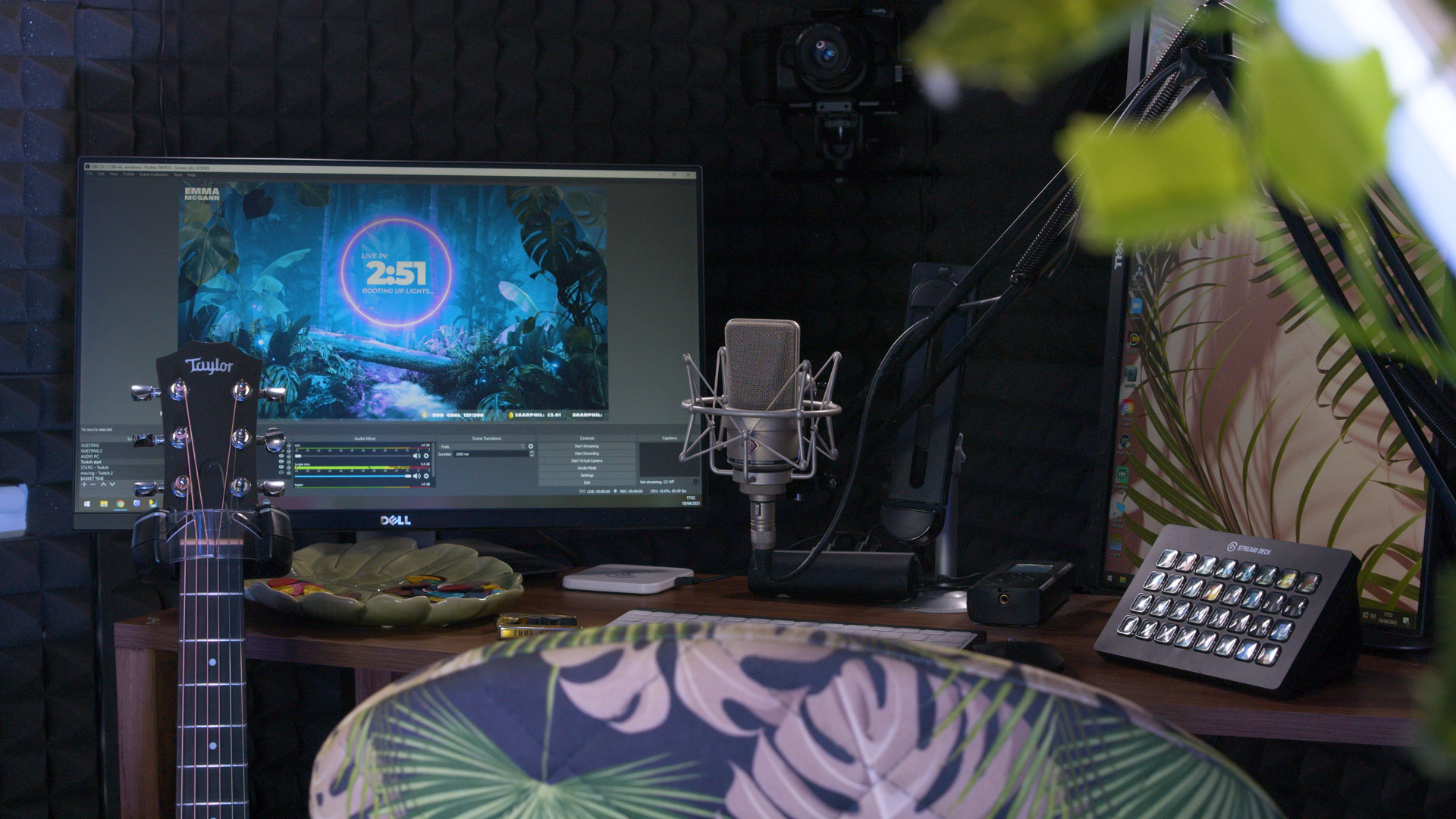
McGann has cultivated an ideal musical space for her livestreams, a special filming studio complete with tropical backdrop and vivid fluorescents whose retro neon vibe matches her heterochromatic hairstyle. The room has a highly distinctive aesthetic, nailing down a key element in the recipe for successful livestreaming: recognition. Arrive at one of McGann’s Instagram posts or videos on TikTok and you immediately know that you’re in her world, the iridescent lights and leafy background an instant tell. It’s just one element of the musically idyllic space she’s created, which is also equipped with camera rigs, recording gear, her digital audio workstation (DAW) and whatever guitar—often a Taylor—she’s selected for a performance. 

Since so many artists are trying their hand at livestreaming on social media, we asked McGann to put together a guide for new streamers on the essentials of performing music, filming videos and interacting with fans in an online context. Watch the video and learn how an experienced pro crafted her perfect musical ecosystem. 

Taylor’s Pandemic-era Contribution 

For those of us here at Taylor, the desire to keep making music stemmed from our heritage as guitar builders, our relationships with the broader music community, and a simple hope that what we do in our corner of the music world could in some small way help people get through a difficult time. So while we forged ahead as best we could with what we do best, we were also reaching out to our artist family, making calls to our content-creator friends and, eventually, recording music. The result was an original song, penned by Keith Goodwin and mixed by Gabriel O’Brien, called “I Know What Love Is (Because of You).” 

Originally written by Goodwin to commemorate his mother-in-law who battled illness in isolation during the COVID crisis, the Good Old War frontman teamed up with Taylor’s own Jay Parkin to turn the song skeleton into a fully imagined single. After crafting the song and recording several tracks, though, the duo was inspired to do even more. 

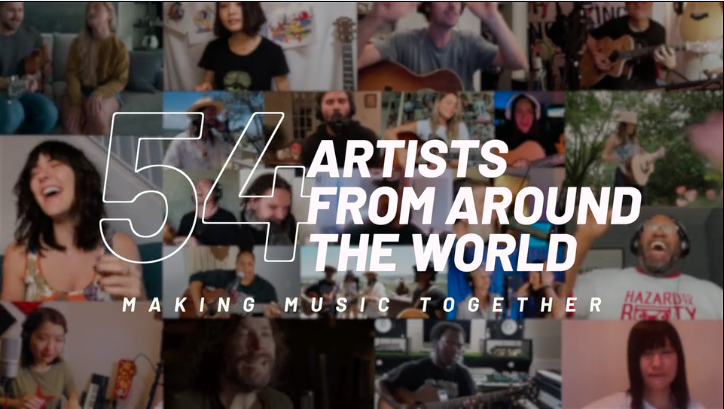
With a finished song in hand, Goodwin and Parkin reached out to artists around the world—Taylor players and singers and songwriters and sound engineers—to seek contributors for the song. Some added new parts on guitar, keys or bass, while others lent their voices to verses and backing vocals. In the end, more than 50 artists joined the project, including Zac Brown, KT Tunstall, Jason Mraz, and many more, sending in hundreds of tracks that were funneled to audio engineer Gabriel O’Brien, frequent Taylor collaborator and multi-talented recording whiz. After a heroic effort on O’Brien’s part, the song came together as a single with an accompanying music video.  

Over 50 artists from around the world contributed parts to “I Know What Love Is,” which continues to generate donations for the MusiCares foundation.

As of publishing time for this story, “I Know What Love Is” had tallied over 1 million streams on Spotify, plus over hundreds of thousands more on other services. It’s also been played by radio stations across the United States and featured in publications like American Songwriter and others.  

To boot, the song has raised thousands of dollars for MusiCares, an organization under the GRAMMY Foundation that provides critical support to individuals and families who depend on the music industry for their livelihoods. MusiCares has been an essential resource for music industry professionals, especially those whose work in the backgrounds of concert venues, tour busses and recording studios makes creating and performing music possible. The organization’s mission is wide-ranging, providing everything from basic necessities and rent assistance to mental health care and substance abuse counseling. That’s part of why Keith Goodwin was so passionate about writing the song and making sure it reached audiences, he says—MusiCares has made a significant impact for him and the people he loves. 

Watch Keith Goodwin play a stripped-back version of “I Know What Love Is.”

“MusiCares pretty much saved the lives of a few of my best friends in the world,” Goodwin says, “by helping them get through rehab. I want to help MusiCares whenever I can.” 

For others involved in the project, such as superstar producer Will Yip, the idea of lifting up the broader music-making community was also about keeping music alive during a difficult time. 

“Those artists, crew, engineers—they need help,” Yip says, “because the world needs them. The world needs their artistry. I couldn’t be more grateful that something like this exists.” 

Al Bettis and his band play “I Know What Love Is.”

Recently, we were able to arrange meetings with Keith Goodwin and a few other artists who were involved in creating the song. They shared stripped-back renditions of “I Know What Love Is.” That these solo performances of a song that originally involved so many different artists can maintain and even build on the song’s potent emotional message is a testament both to Goodwin’s songwriting and to music’s power to emotionally connect us to a larger world. 

No one can deny the impact that the pandemic has had on the global music industry, and for many people, the past year has been about weathering the storm and nothing else. But strange circumstances make for unpredictable outcomes, and music found a way not just to endure but, in some ways, to thrive. From the livestreaming explosion to the rapid musical evolution taking place on social media to the inspiring solidarity found within the industry, music always finds a way.  

The Wood&Steel Playlist: June 2021

Scroll Down

From Judith Hill's soulful, rousing new R&B to the indie rock of Manchester Orchestra, enjoy a selection of new and recent tracks from the Taylor artist family.

The arrival of summer (make that winter for our friends in the Southern Hemisphere) gave us the perfect excuse to load up a fresh Spotify playlist featuring an eclectic lineup of Taylor artists. With any luck, our latest showcase will deliver some fresh discoveries that lead to deeper musical explorations.

Wood&Steel Summer 2021

Wherever you are, whatever your plans may be over the next few months, we hope you have a chance to relax, play some guitar, get together with friends you probably haven’t seen in way too long, and listen to some great tunes.

large stack of compressed plastic wrap with a sign in front reading

Bad Wrap: Inside a Growing Plastic Problem

Scroll Down

Developing more sustainable business practices starts with identifying areas for improvement. Our use of plastic stretch wrap is one of them.

For years now, we’ve been reporting on Taylor’s efforts to develop more sustainable business practices. Our most prominent initiatives — and storylines — have keyed in on our tonewood supply chain and our drive to cultivate a healthier future for the woods we use, including the communities that support those sourcing efforts. The “Big Three,” as Taylor Director of Natural Resource Sustainability Scott Paul calls them, are the Ebony Project in Cameroon, which has funded groundbreaking research into ebony ecology and spawned a scalable (and growing) community replanting program; native forest restoration in Hawaii, including the planting of koa trees; and our burgeoning Urban Wood program, which aims to create a circular economy by making guitars with wood from end-of-life urban trees and stimulate increased replanting projects in those communities.

While we’re proud of the progress we’re making on those fronts, our commitment to ethical practices demands that we scrutinize every aspect of our operation. More specifically, we need to look for areas in which we’re falling short and work toward better solutions. 

This mindset has led to a comprehensive review of our manufacturing processes and campus operation. Over the last couple of years, Scott Paul has used the lens of sustainability to lead an internal audit to identify our successes and shortcomings. While we’ve made many improvements (a major reduction of single-use, disposable products on campus, more EV charging stations, a robust battery recycling program, water-filling stations in buildings across campus, the use of a sophisticated dashboard to better manage our energy consumption needs, to name a few), we recently identified an issue that is quite literally a growing problem for us: plastic stretch wrap. We’re talking about the plastic film we use to secure pallets of stacked guitars (in their cases) being transported, or to wrap wood we move around on pallets.  

While the wrap plays an essential role in protecting valuable parts and goods in transit, given the volume of our operation, we go through a good amount of the stuff. While it’s nowhere near the consumption levels of a big box store, it adds up. 

In the past, we would bale the used wrap, and our recycling vendor would sell it to a broker, who in turn would send it to China to be recycled. But in 2018, China banned the import of most plastics, and we’ve subsequently learned that there’s a strong likelihood the plastic was in fact just being dumped overseas or worse — burned in local communities. We’re now struggling to find a U.S.-based company that will recycle it. We’ve contacted other businesses, large and small, to see what they do with theirs, only to find that no one else seems to have a viable solution right now either.  

We’ve also talked to several service providers and asked each of them the same set of questions: Will they re-sell it? What are they going to do with it? If recycled, into what? How far will it be trucked or shipped? Will it be exported? As it turns out, most shrink wrap is now being landfilled or incinerated, just as it likely was in China. 

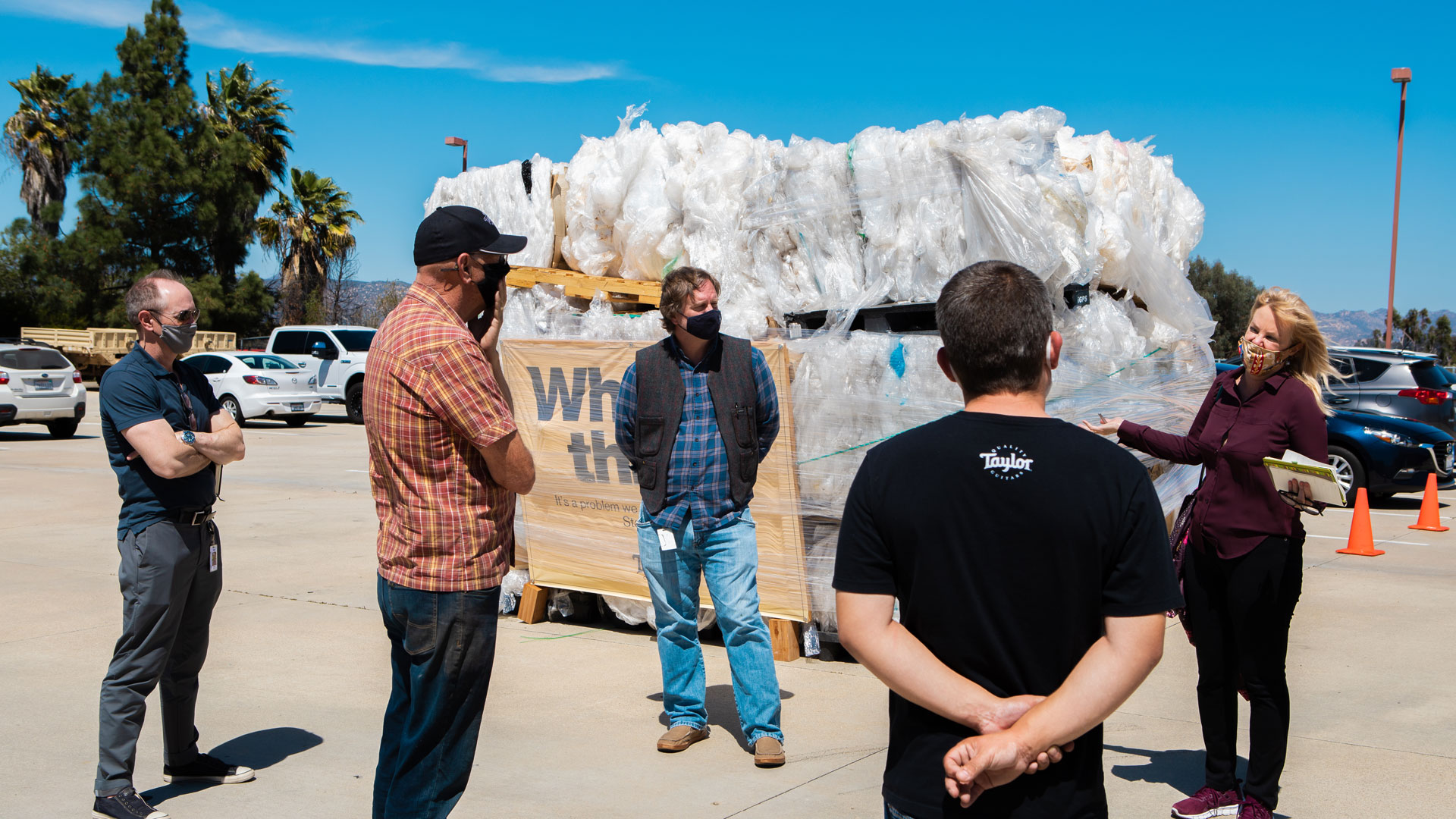
We wouldn’t mind paying to recycle the plastic wrap if it were happening responsibly, in a safe, environmentally-sound facility, but we don’t want it added to a landfill or incinerated. Yet we don’t currently have a solution. And with each day the problem grows. So, in the meantime, after consulting with Scott, Bob Taylor decided our first step toward a solution would be to amplify the problem by making it more visible to everyone on campus. Our facilities team started moving bales of our used stretch wrap to the middle of the parking lot outside our shipping warehouse, and adding what we accumulate to it each month — about two to three bales. We currently have a small mountain in the making. We even created a display sign with a thought-provoking message to employees: 

What Is This? 

It’s a problem we’re going to address. Stay tuned. 

What’s more, the bales only represent about half of what we use to wrap guitars; the other half leaves our facility when we ship pallets. 

Scott Paul points out that this plastic wrap problem isn’t exclusive to Taylor. 

“Think of all the shrink wrap discarded from big box stores, supermarkets, and retailers all over the country,” he says. “Most of it is being landfilled, and some is being incinerated.” 

Scott and others on our company’s “Green Team” committee began to investigate possible solutions, including alternative recycling options and the use of other materials that were easier to recycle. Scott also reached out to an expert who might be able to help. 

Jan Dell is a chemical engineer with 30 years of experience, having worked in 45 countries for major corporations in the manufacturing sector. During her career, she led programs to implement sustainable business and climate resiliency practices for the likes of Nike, Gap, Mattel, and others.  

In 2018 she pivoted in her career, became independent, and started an NGO called The Last Beach Cleanup to stop plastic pollution. One of their priority campaigns aims to stop plastic waste exports to poor countries. In 2019, she was named a National Geographic Explorer and received a small grant to help cities reduce plastic pollution. She was also named to California’s Statewide Recycling Commission in 2020. 

In April, Dell visited the Taylor campus to meet with Scott Paul, Bob Taylor and a small group of other Taylor employees who are part of our informal task force — gathering, appropriately, in front of our hill of plastic — for an introductory conversation. Dell shared some of her knowledge, including the reality check that only a small fraction of plastic waste made is actually recycled. She noted that 3.4 billion pounds of plastic film waste are generated in California alone each year, but that there are only a few plastic film recyclers in California and Nevada, and they  can only reprocess about 100 million pounds of it. That’s about 3 percent, so it’s no surprise that Taylor’s plastic heap is growing.  

We’ve explored the use of alternative plastic wrap products that are marketed as being biodegradable, but we found that they work less effectively, and Dell says there are other obstacles preventing its wider use, like the fact that most composting operations don’t want to take bioplastic waste because it doesn’t safely biodegrade and becomes contamination in the compost. 

“And today’s landfills are designed to store materials to prevent methane emissions, so the plastic film won’t biodegrade and won’t disappear in a landfill,” she says. 

Dell advised that the best course of action Taylor can pursue is to continue to minimize plastic use where possible. Taylor can also create greater demand for plastic wrap that has a percentage of recycled content by asking our vendors to supply it and by encouraging other companies to do the same. This will help scale up the supply chain infrastructure around the product and accelerate usage. 

Meanwhile, our plastic display has already made an impact on Taylor employees. After we showcased the issue in our internal newsletter, a number of Taylor employees — make that new employee-owners — have taken the initiative to find ways to reduce our stretch wrap consumption in their departments.   

In the meantime, we’re continuing to educate ourselves with the help of people like Dell and actively pursuing better options. We’ll be sure to keep you updated on the status of our plastic waste and the alternative solutions we develop. 

Guitar Lesson

Open Minor Tunings

Scroll Down

Want an easy way to broaden your musical range with open tunings? Try open minor.

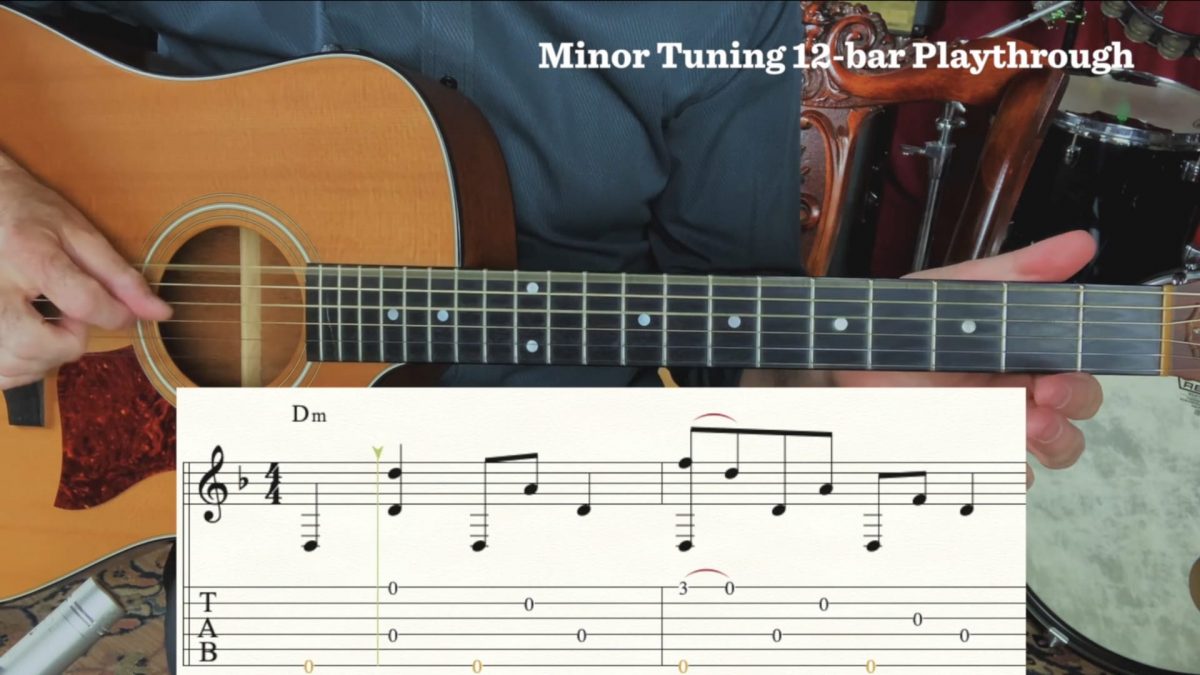
From Leo Kottke to Joni Mitchell, Muddy Waters to Jimmy Page, Elmore James to Kaki King, open tunings — altering standard tuning (EADGBE) to pitches that create a chord when all the strings are played open — can be heard on countless classic recordings. In my experience, by far the most ubiquitous of the open tunings are the major sounds, specifically open D and open G, both of which hold their own special charms. However, there is a secret that open minor tunings — in the case of this lesson, open D minor and open G minor — possess that can effortlessly generate more variety than the major tunings: It’s the little-known fact that, by adding one finger to any of the minor chords, one can instantly turn it into a major chord, thus giving players more harmonic range. This trick is not so easily performed in open major tunings. Thus, this lesson demonstrates how to double your harmonic possibilities with just one finger.

Download the Lesson

View and print music notation for Shawn’s guitar lesson.

Download File

  • 2021 Issue 1 /
  • Guitar Lessons: Tone, Posture and Using a Capo

Guitar Lessons: Tone, Posture and Using a Capo

Scroll Down

Watch guitarist and music director Nicholas Veinoglou demonstrate some simple tricks that can help you expand your guitar’s sonic palette and refine your playing technique.

By Nicholas Veinoglou

Whether you’re a seasoned guitar player or a beginner just stepping into the world of music, having a good understanding of some acoustic guitar basics can keep your practice sessions productive and help you expand the musical breadth of your guitar and your playing. Enjoy these quick guitar lessons from Nicholas Veinoglou, a longtime Taylor player and guitar teacher extraordinaire.

Playing Posture

How you hold your guitar when you play can have a dramatic effect on your technique. Follow Nicholas’s advice to straighten out your posture, stay comfortable and let your body work with the guitar.


Tone Tips

Despite its traditional design, the acoustic guitar is capable of producing a wide range of musical colors depending on how you play it. Watch Nicholas run through a few easy ways to get new sounds out of your guitar.


How to Use a Capo

A capo is an essential piece of any guitarist’s toolbox, allowing you to change the natural key of your acoustic guitar without retuning so you can play and sing in a range that fits your abilities. Here, Nicholas demonstrates how and when to use a capo with your acoustic guitar.

Recurring Dream

Scroll Down

Originally conceived as a limited-time release during the pandemic, our American Dream Series has earned a permanent place within the Taylor line.

It’s safe to say that most of us were eager to turn the page on the year that was 2020, even if the new calendar year was merely a symbolic reset. The sustained turbulence of the past months has tested the resolve of many, and challenged us all to adapt to our new realities on the fly.

From our vantage point at Taylor, we especially felt for the community of musicians and others in the industry whose livelihoods suffered as a result, along with fans who were unable to enjoy the shared pleasures of experiencing live performances together as a group.

Yet we also were reminded of the essential role music plays in helping us get through tough times, and that we will always find ways to make and share it. Even with gigs cancelled, artists have devoted time to writing and recording music at home, they’ve collaborated remotely with bandmates, and they’ve found new ways to engage with fans through streaming video platforms. Meanwhile, many of us discovered, or re-discovered, the joy, the comfort, the cathartic release of picking up an instrument and making music ourselves at home, in some cases together with our families. 

Here at Taylor, we had other challenges to contend with as a business that had been forced to press pause on our guitar production in March of last year. We knew that making guitars would be the way forward for us. But times had changed, and we knew we had to respond by making guitars that were right for the moment. 

Those circumstances gave birth to our American Dream Series, conceived by master builder Andy Powers and Bob Taylor, and named for the shop where Bob and Taylor co-founder Kurt Listug met and launched their own guitar company. The American Dream name was more than a historical footnote or marketing moniker. It was an apt affirmation of Taylor’s resilient, problem-solving spirit, which has become a defining aspect of our culture. 

Singer-songwriter Josh Krajcik plays his song “Close Your Eyes” for an episode of Spaces, our video series of intimate at-home artist performances.

Given the unique circumstances of operating during the pandemic, developing and launching the American Dream guitars required a level of creative synergy unlike anything we’d encountered throughout our nearly five decades of guitar-making. It also happened within a compressed timeframe, notes Taylor VP of Sales Monte Montefusco, who was in the thick of it. 

“The speed at which this project came together was like nothing we’ve experienced before,” Montefusco says. “We knew we had to act fast, but we had no idea how fast we could act in these circumstances. It was an incredible team effort that resulted in remarkable success during unprecedented times.”  

The American Dream design was informed by a streamlined, “everything you need, nothing you don’t” ethos, with workmanlike features that were distilled into the ideal blend of pro-level performance, utility and affordability. We knew we wanted these to be all-solid-wood guitars that we could make in our El Cajon, California, factory. We needed to work with the wood inventory we already had in-house, and limit the additional tooling time that might be required to make the guitars production-ready. We also wanted to make these guitars more affordable than any U.S.-made, all-solid-wood guitars we were currently offering. 

man playing Taylor American Dream AD17e Blacktop acoustic guitar with microphone

We launched the series last June with a trio of versatile Grand Pacific models: two featuring ovangkol backs and sides paired with a spruce top — one natural, the other a blacktop edition — and another with sapele back and sides and a mahogany top. In the ensuing months, dealers, artists, reviewers and recreational players have gotten their hands on these guitars and had a chance to form their impressions. 

Though each player can claim their own distinct experience with the guitars, the response has been consistent: that these guitars are the real deal, impressing players with their tonal warmth, playability and accessibility.  

Review Highlights 

For the ovangkol/spruce AD17 and the AD17 Blacktop, reviewers such as American Songwriter’s Andy McDonough praised the guitar’s quick response and power. 

“The AD17 has a big sound, rich tone and pleasant definition that requires little effort to play,” he writes, “but it’s also very responsive up the neck and articulates well for both picking and finger-style playing. The warm low end can fill the room with strumming sounds…. The guitar has great volume and dynamic characteristics, and a long, beautiful sustain.” 

The American Dream Series owes much of its superior resonance and sensitivity to the tone-enhancing framework of V-Class bracing, which adds considerable power and helps notes ring out longer before decaying. The result, notes Guitar.com’s Michael Watts in his Big Review, is a sound with impressive sonic texture and complexity. 

There’s a beautiful dry shimmer to the top end and impressive sustain attributable in no small part to the V-Class bracing. 

Michael Watts, Guitar.com

Other reviewers responded to the woody, unprocessed look and sound of the guitars. These models owe their naturalistic character in part to the super-thin 2-mil matte finish, which preserves the original porous texture of the tonewoods, and in part to their unbound edges and spartan appointments. In their exploration of the American Dream Series for their Tone-Lounge Sessions videos, reviewers Neville Marten and Richard Barrett commented on the aesthetic sensibility that connects these guitars’ visual cues to their musical capabilities. 

“The chamfered edges make [these guitars] feel really organic,” Marten says, “and they sound organic too….It’s a very focused sound with rich mids, perfectly voiced for miking up. They don’t sound ‘produced’.” 

That sonic character is right in line with how Andy Powers designed the Grand Pacific body shape, which lends each of the American Dream models the traditional visual appeal of the round-shoulder dreadnought style. Reviewers continue to appreciate the Grand Pacific’s seasoned tonal output, including Peghead Nation’s Teja Gerken, who commented on how the mahogany-top AD27e’s musical profile bears out that vintage-hued sound while maintaining balance that should make it appealing to all sorts of players. 

woman playing Taylor AD27 acoustic guitar on bench

“The AD27e had a great overall tonal ‘roundness,’ with a lovely warmth in the bass, and the slightly compressed dynamic range that hardwood-top guitars are known for,” Gerken says. “These qualities made the guitar an excellent strummer, but it also had a lovely balance for playing fingerstyle. The instrument’s relatively large body produced respectable volume, and I wouldn’t hesitate to recommend the guitar to players looking for a single guitar to cover many styles.” 

Gerken also describes how the optional Expression System 2 pickup and preamp translates that warm, round tone during plugged-in playing sessions. 

“Plugging into a Fishman Loudbox Mini continued the impression that the AD27e offers fully developed Taylor character,” he says. “In fact, in an amplified setting, it might be hard to hear any difference between the American Dream and higher-end Taylors, which use the same pickup and electronics package.” 

In faithful Taylor style, playability and feel are just as central to the American Dream experience as tonal quality. With chamfered edges in place of traditional binding, each American Dream guitar feels accommodating, whether you’re a new player or a seasoned pro. In his detailed review of the Series for Guitar Player, Art Thompson pointed out how each element of these guitars is crafted to deliver a rich playing experience.  

“The C-shape neck feels great with its medium depth and a width of 1-3/4 inches at the nut,” Thompson says. “The string spacing is easy to navigate, whether soloing or fingering complex chords, and the factory setup was well dialed-in on arrival, providing low and buzz-free string action and rock-solid intonation all along the neck.” 

Thompson also lauded the intimate, inspiring feel of these instruments. 

“The way this lightweight guitar transfers string vibrations through the body and neck is unreal,” Thompson writes. “It’s resonant and dynamic, and the touch responsiveness is something fingerstyle players will appreciate.” 

woman playing Taylor American Dream acoustic guitar at open mic show

Guitar World’s Chris Gill, who reviewed the AD17e Blacktop, also loved the handfeel. 

“Playability is simply superb, with the neck providing a smooth slinky feel that lives up to the ‘dream’ designation of the series name,” he writes.  

Gill also keyed in on the unique tonal character compared to other traditional dreadnought guitars. 

“Befitting its large, dreadnought-style dimensions, the AD17 delivers powerful volume projection but, unlike the typical scooped mids of a dreadnought, its midrange is impressively boosted, providing a rich, sweet, well-balanced voice that is ideal for fingerstyle as well as punchy rhythm playing,” he says. In the end, Gill gave the guitar the magazine’s Gold Award for Performance. 

Artist Reactions 

Of course, we were eager to get the American Dream Series into the hands of artists. A testament to the broad appeal of the Taylor design philosophy, our artist roster includes songwriters, producers, engineers and performers of all stripes, from longtime industry vets to emerging artists refining their musical skills and style. 

UK singer-songwriter Cat Burns loved how approachable the American Dream Series feels for a musician like her, who has developed a distinctive musical voice and is just beginning to introduce acoustic sounds to her music. After watching Cat play her AD17 Blacktop on her Instagram feed, we reached out to get her thoughts on the guitar. 

“I’m loving the American Dream so much!” she said. “As someone who’s currently learning the ins and outs of the guitar, this is the best one to have. It’s so easy to play and it feels fantastic.”

Matt Beckley, who has written, produced and recorded songs with artists including Switchfoot, Justin Bieber, Camila Cabello, Avril Lavigne and Jewel (among many others), provided the unique perspective of a player who often hears things from behind the control panel. Beckley loved the aesthetic of the AD17 Blacktop, among other things. 

“I originally picked it because it was black,” Beckley says. “I kept it because I have eight acoustics, and this one quickly became my favorite to play and record with. It’s got the classic slope-shoulder vibe, but with Taylor’s legendary consistency. That’s a win/win. Plus, it’s black. 

“I love everything about it,” Beckley added.

It sounds right. It plays right. It’s not flashy — everything you need, nothing you don’t. It felt like an old friend almost immediately. 

Matt Beckley

Across the board, players and reviewers alike echoed Beckley’s reaction, responding to the distilled, honest, straightforward appeal that comes with the pared-back design and music-forward nature of the American Dream Series.

Above all, our goal with the American Dream Series was to meet the needs of the everyday guitar player with a new line of instruments that could fuel creativity during a time when we all need music more than ever. We hope that guitarists everywhere can enjoy the American Dream Series and continue to lean on music as a source of healing and togetherness. 

You’ll find our American Dream guitars at authorized Taylor dealers everywhere. For additional content including demo videos and more, visit taylorguitars.com.  

shawn persinger playing taylor acoustic guitar

Best Practices

Scroll Down

With more people embracing the guitar in recent months, learning how to practice is important. So is making time to have fun.

Anyone affiliated with the guitar business — manufacturer, retailer, consumer, artist, journalist, etc. — will tell you this time of COVID has been an unusual one for everyone involved. Just a couple of years ago, major media outlets — The Washington Post, Billboard, Fortune, et. al. — were lamenting the decline of the guitar. And then suddenly in the summer of 2020, guitars were in such high demand that manufacturers couldn’t keep up, stores lacked stock, and players searched for everything from Strats to strings. Indeed, it appears that when the going gets tough, the tough get guitars!

This brings me to the topic of practicing. As an instructor, normally the most common complaint/excuse/reasoning I hear from students regarding their slow progress (their judgement, not mine) is a lack of time to practice. Thus, under the recent circumstances, many players are discovering whether it’s genuinely time that is the adversary or perhaps a misuse of time. 

But maybe progress doesn’t matter so much right now. How about fun? Having more time to play is as important as time to practice. I’m hoping that you are finding a balance. That’s what this article reflects upon: recognizing the importance of music in our lives and helping you create a musical environment in which you — whether beginner or veteran — can practice, learn, grow, create, share and have fun.  

Play Something You Love 

Just play. Pick up your instrument and have fun. Play that song you’ve played a thousand times as if it’s the first time. Remember? Boy, that felt good.  

For me, there are two pivotal moments in my guitar career that have stuck with me. The first was learning how to play the rhythm guitar of the Scorpions’ “Rock You Like a Hurricane.” Mind-blowing! It almost sounded like a song when I played it! It sure beat those first-position G and C chords in the Mel Bay book. To this day, if I want to refresh my playing, all I have to do is bang out the song’s slyly syncopated power chord intro and I’m transported to being a 13-year-old novice, eager to play, practice and learn more.  

The second guitar event embedded in my brain, and the reminder of which keeps me zealously keen to improve, happened a few years later, when my playing had progressed ever so slightly. The extraordinary experience occurred one afternoon as I gingerly fingerpicked my way through J.S. Bach’s “Jesu, Joy of Man’s Desiring” with rapturous delight. Today, as I revisit this singular piece, I am enveloped by two sensuous memories: First, the thrill of my ability to play — even poorly — such a monumental composition; and second, the accompanying realization that my girlfriend at the time would be spellbound. (I’m not sure she was, but self-delusion does have its benefits.)  

Hence, we recognize that playing the guitar goes beyond the aural and immediate. It resonates through time, emotionally, physically and spiritually. The songs you love, which you then learn to play, will have lasting impact on you, so recognize and relish those euphoric moments. While they might not materialize as often as you’d wish, that’s one of the things that makes them special.  

Slow Down 

Of course, the reason I had the ability to play Bach barely passably was because I had practiced for several years (although the motivation of showing off to a significant other shouldn’t be ruled out). That and I had the tablature. So it was that the routine of play, practice, play, practice (or practice, play…) became central to my existence and remains so to this day. No doubt, this is true for many of you. Nevertheless, even with the time and motivation, plenty of guitarists struggle with what, and how, to practice. While there are many answers to these questions, there is one specific guidepost that should help any musician strengthen his or her practice efficiency: Slow down! 

Watch Shawn demonstrate his technique for practicing with a metronome.

I can’t tell you how many times various students have confessed, “I’ve been playing this piece for years, but I always mess up this one section.” And the sections run the gamut from a tricky fingerstyle combination or a fast alternate-picking run to a seemingly unattainable seven-fret stretch or a poorly executed B minor chord. 

I have found that simply slowing down works wonders for these ostensibly unsurmountable hurdles. But you must play painfully slow, much slower than you naturally enjoy. If the performance tempo is 120 bpm — that’s the metronome set at 120 with one quarter note for every click — then you should practice as slowly as 30 bpm, four times slower than performance. This will be excruciating! In fact, 30 bpm on the metronome will seem so impossible that I suggest setting it to 60 bpm and playing one quarter note for every two clicks (this is the same as quarter notes at 30 bpm, yet it feels faster due to the more frequent clicks). What most players discover is that it’s not the collection of notes that is tricky; it’s playing the notes up to tempo. Still, many guitarists are unwilling to slow passages down, deluding themselves into thinking they are obliged to practice the piece all the way through at the same tempo. No. Exceptional players do not practice this way. Performance tempo should be consistent, but practice tempos vary. Each individual phrase requires its own practice tempo. 

Once you can play your previously troubling phrase at 30 bpm, then you’ll recognize you can in fact play the music! Next, you merely start speeding it up, two metronome clicks at a time. That’s right, from 30 to 32 bpm, which will be tedious, yet will yield results. Continue this approach — which may take months, two to four metronome clicks every day (this may seem like a long time, but I’ve known players to carelessly practice such phrases for years and never attain them) — until you find your own performance tempo.  

Here’s the rub: You may never get the part up to the original performance tempo. This is the nature of game. Some players are simply faster than others, the way some athletes are faster, bigger, stronger, etc. Still, none of that means “better.” So, find your own performance tempo, and then bring more of yourself to the piece. Remember, you possess your own sound, tone, phrasing, attack, texture, etc. If you highlight those qualities, I promise you, no one will ever complain about the tempo.   

At the risk of generalizing, when new techniques and songs begin to come naturally to longtime players — even after years of unnatural hard work — those same players tend to maintain no patience for slowing down new onerous phrases (old ones even more so), choosing instead to complain that the unfamiliar notes are too laborious. Consequently, they rarely progress beyond a certain threshold. Thus, we see that it isn’t only skill that produces the better player, but patience as well. Beginners should heed this lesson and make slow, deliberate practice a habit from the onset.  

Make a Video (Just Don’t Post It!)  

One invaluable piece of advice I impart to students is that they play with other musicians as much as possible. For a multitude of reasons, jamming with another musician can improve your playing dramatically. Sadly, during the prevailing social distancing epoch, musicians have fewer opportunities than ever to fraternize. Thus, I offer, if not an equal substitute, a worthwhile auxiliary (one you should continue post-COVID).  

Shawn reviews how recording your practice sessions on video can elevate your playing.

Start video-recording your practice routines and watch them immediately! Scrutinize. When you watch yourself, study what’s working and what isn’t. If it is working, don’t change anything, even if your technique appears awkward. As long as it sounds good, it is good. I don’t buy into the dogma that there is one perfect technique or style of playing. If it works for you — or Hendrix with his thumb over the neck, or Jeff Healy with the guitar lying flat, or Django with three fingers — that’s what matters. The only times I suggest changing a student’s technique are when it’s causing pain or the student isn’t improving.

Hopefully, in your video, you’ll see and hear right away whether it’s working or not. If it isn’t, experiment with alternatives. Spend some time researching variations online. (Though there are countless video lessons of varying quality, I have found the cream does rise to the top, so study the most popular lessons first.) Make research part of your practice routine. Ten to 20 minutes of searching for the lessons that suit you best can be worth a lifetime of musical pleasure! Afterward, bring the fruits of that labor into your playing and shoot another video. Seriously, endeavor to film and watch all of your practice routines for the next week to a month, and see if it elevates your playing. It was Socrates who wrote “The unexamined life is not worth living.” My riff on that might be, “The unexamined performance is not worth hearing.”

Do understand, you are using video to help accomplish your goal, not to document the goal. So don’t post these practice videos online; they are for your eyes and ears only.

Last Word 

I must warn you that even if you do implement the suggestions I’ve offered here, your guitar life will probably still be uneven. That’s to be expected. The performance and study of music are an everlasting pursuit. There will be good days and bad days; arguably more bad than good if you are persistently striving to improve. Though, ironically, a bad day conquered can be more gratifying than a good day under-appreciated. As stated from the outset, I hope you’re finding a balance between the fun and the work during this complicated time. History will look back on this period with a multifaceted lens, and there is no doubt that music and the arts will have played a role in easing the hardships. Thankfully, once we’re onto greener pastures, the music will still be there.  

Artist Spotlight: FINNEAS

Scroll Down

The GRAMMY-winning artist/producer comes up for air during a fertile creative stretch to share why a good acoustic guitar is an indispensable songwriting tool and what he likes about the new Taylor GT.

Despite forcing most of us into social isolation and cutting off creatives from their typical sources of inspiration (and revenue), the coronavirus pandemic has not broken the spirit of the music industry. Among those keeping the dream alive is FINNEAS, a prolific singer-songwriter, producer and multi-instrumentalist who has emerged as a potent force in the world of pop music despite largely working out of his bedroom.

After a stint as an actor headlined by a run on the hit show Glee, FINNEAS first entered the musical limelight through his work with his sister, Billie Eilish. The sibling duo’s murky, seductive flavor of pop has dominated the charts for the last couple years and set a relatable soundtrack for a world in the midst of growing uncertainty. With five GRAMMY awards already under his belt at the ripe old age of 23 (including Producer of the Year, Non-Classical, in 2020), FINNEAS has emerged as a confident artist in his own right, tallying over 640 million streams across major platforms and earning three more chances to add to his GRAMMY collection in 2021. 

Click to Play
Click to hear FINNEAS’ hit “Break My Heart Again.”

Listening to his music is like touring a hi-fi exhibit of modern musical technique: Songs ricochet from fuzzed-out acoustic guitar fingerpicking to barroom piano melodies paired with his smooth croon to bouncy club rhythms powered by booming basslines and thundering percussion. It’s a vibrant, textured style that blends acoustic sounds with techno electricity and a healthy dose of R&B soul, reflecting the spirit of an experimenter who can both take another artist’s work to the next level and formulate potent sonic mixtures on his own.  

Having honed his skills and sound using mostly instruments within arm’s reach at his home, FINNEAS has developed a fast-paced, improvisational working style that demands both performance and accessibility from his gear, especially his guitars. When an idea comes to mind, it’s whatever instrument close at hand that will translate it into sound, a creative quirk that shines through in his chameleonic music. To earn its place in his studio, an instrument must be resilient enough to keep up with his busy schedule and spontaneous creative patterns while also serving up an inspiring musical character.  

Recently, Taylor built FINNEAS a custom all-white Grand Pacific model for live shows and studio work. As we readied the launch of the new GT body shape, we knew he should be among the first wave of artists to test-drive it. We were thrilled to get one of the first completed GTe Urban Ash guitars into the hands of a busy working musician, and happy to hear that it had become a staple his musical toolbox. 

Even in a pandemic, FINNEAS is in high demand — he’s been writing furiously with his sister while hunkered down at home in the Los Angeles area, and most of his remaining time is devoted to keeping up with an array of collaborations-in-progress. In December, he pressed pause to join us for a round of rapid-fire questions about his experience creating music under quarantine and his unique approach to songwriting and producing with acoustic guitars.

FINNEAS’ debut solo album, Blood Harmony, was released in 2019 and reissued in 2020 with new singles. You can hear his work on all major streaming services.

What role does guitar (acoustic guitar specifically) play in your creative process?

If a song sounds good on an acoustic guitar, I know it’s going to sound good anywhere — so I always like to start writing that way. 

How has your creative process changed during the pandemic?

If a song sounds good on an acoustic guitar, I know it’s going to sound good anywhere — so I always like to start writing that way. 

What do you need from an acoustic guitar for your style of writing and producing?

Dynamics, clarity, body. 

What do you need out of a guitar for performances?

Durability — and it has to look cool.

What makes a guitar like the Taylor GT useful for a musician like you?

It’s just a great guitar. It makes my job a whole lot easier. 

How does playing the GT compare to playing your full-size custom white Taylor Grand Pacific?

I love the portability of it. I don’t like instruments to be in the way — I like them to be as easy to bring with me anywhere as possible. And the sound on this one doesn’t suffer at all because of its size. 

What inspired you to start playing guitar in the first place?

The Beatles.

What do you think about the future of the guitar, especially the acoustic guitar, as a mainstream musical instrument?

Guitar has been reintegrated into essentially every genre in the last few years. That’s so exciting. It’s fun to see people be inventive and creative with guitars in ways that are untraditional.